Why Most AI Pilots Die From an Accountability Gap, Not a Technology Gap
Most AI pilots stall not because the model underperforms but because no one owns the handoff from prototype to production; this post lays out the concrete accountability system (eval gates, data boundaries, named owners) that separates PolicyFlow-style shipped workflows from permanent pilot purgatory.
The Model Isn't the Problem
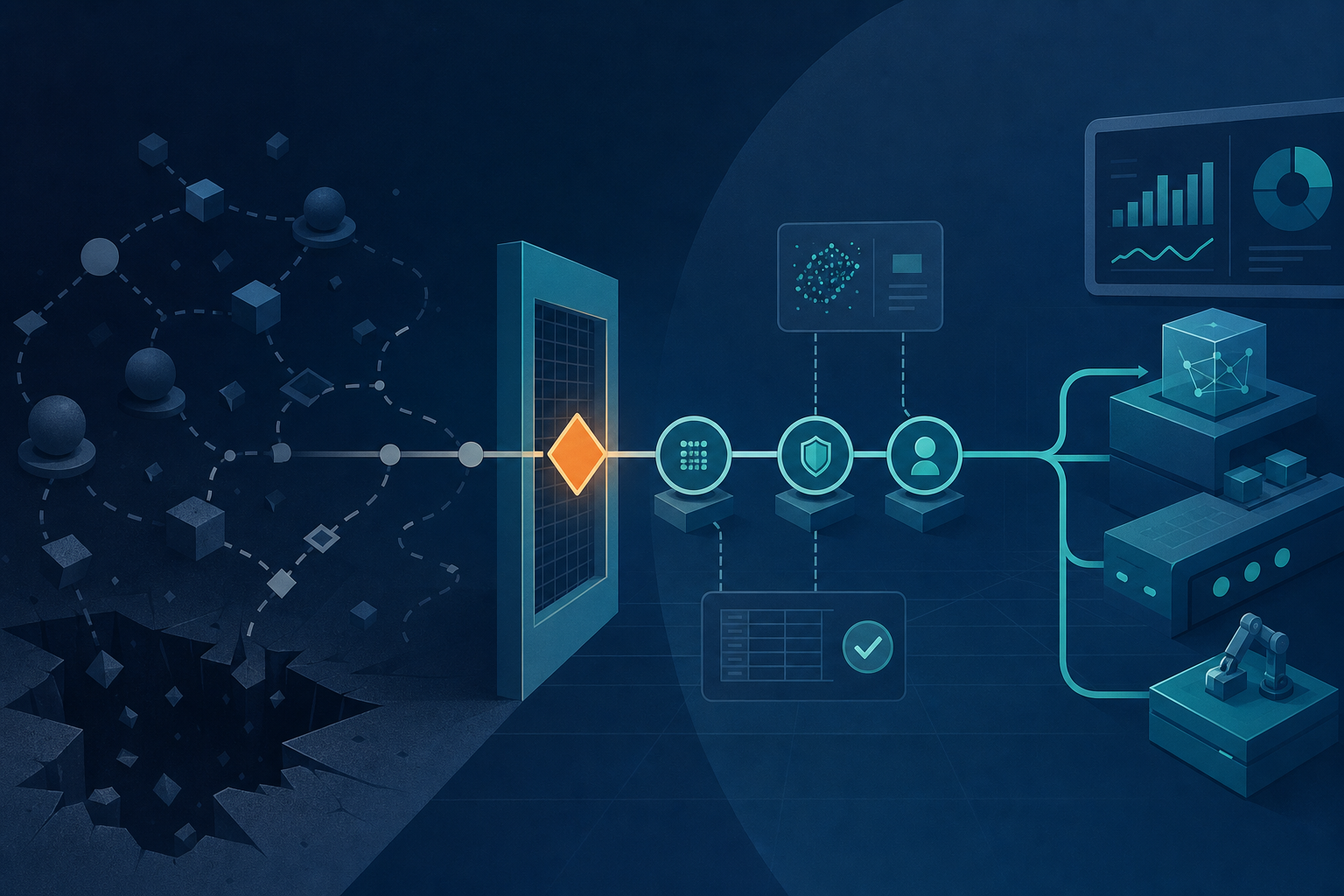
PolicyFlow shipped in three months with one senior engineer and an AI co-pilot. A traditional build with a four-person team would have taken twelve. Same insurance data intake problem, same messy source documents, radically different timeline. The difference wasn't a smarter model. It was that someone owned every handoff between prototype and production, from data validation to the eval gate to the deployment decision. Nobody was waiting for a Slack thread to resolve itself.
Most AI pilots that die don't die because the LLM hallucinated once too often. They die because the prototype worked in a demo, everyone nodded, and then no one could say who was responsible for turning "it worked in the demo" into "it works on Tuesday when the input data is ugly." That's an accountability gap, not a technology gap. It's also the single biggest thing we see when we scope a stalled pilot: not a broken model, but an org chart with no name next to the word "owner."
If that sounds familiar, you've probably already run into the mess that happens right after workflow one ships. We wrote about that specific failure mode in why your second AI workflow is more dangerous than your first, because the accountability gap doesn't close itself just because the first pilot got lucky.
What an Accountability System Actually Contains
A slide deck that says "we take AI quality seriously" is not an accountability system. Here's what one actually looks like:
Evaluation harnesses and quality gates. A defined set of test cases, edge cases, and known-bad inputs that every model change or prompt update runs against before it touches production. Not a vibes check where someone tries five prompts and says "looks good." A repeatable, scored gate that has to pass.
Defined data boundaries. What data can the model see? What can it write to? What's the blast radius if an agent decides, on its own initiative, to call a tool it wasn't supposed to touch? This is where excessive agency turns into an actual incident instead of a hypothetical one, and it's non-negotiable once you're past a single-user demo.
A named owner for every agentic step. Not "the AI team," not "whoever's around." A specific person accountable for what happens when step four of the workflow returns a low-confidence output. If you can't point to that person in a live meeting, the step doesn't have an owner, it has a hope.
This is the same discipline that separates teams shipping their third and fourth workflow from teams stuck rebuilding the first one from scratch each time, a pattern we go deep on in why some teams are shipping their third AI workflow while others are still stuck on their first.
Why This Is Governance Infrastructure, Not a Nice-to-Have
If you're a CTO or CISO, you already have to answer for this, whether or not you've built the accountability system yet. NIST AI RMF asks you to map, measure, and manage AI risk. ISO 42001 asks for a documented AI management system with clear roles. The OWASP LLM Top 10 names excessive agency and insecure output handling as real, scored risks, not theoretical ones.
Every one of those frameworks assumes the same underlying structure: a named owner, a measurable quality gate, a documented data boundary. Build the accountability system described above and you're not doing extra work to satisfy an auditor later. You're building the thing the audit is checking for in the first place. Teams that treat governance as a separate compliance exercise, bolted on after the pilot works, end up redoing the same work twice. Teams that build eval gates and ownership maps from day one just show the auditor what they already have.
We've also written about why the second workflow tends to expose gaps the first one never had to face, because a single pilot can survive on one champion's diligence in a way that a growing AI footprint cannot. See why your second AI workflow needs governance the first one never had if you're past pilot one and starting to feel that pressure.
The Pre-Budget Case: Accountability and Cost Discipline Are the Same Discipline
If you're building next year's AI roadmap right now, the case you need isn't "AI is strategic." It's a number your CFO can hold. SoloStream got built by one engineer with an AI co-pilot in about three months, at roughly 80% lower cost than a traditional build that would have run close to $500k. That number didn't come from a smarter model either. It came from the same thing PolicyFlow had: clear ownership at every step, so nobody was burning weeks re-deciding who approves what.
That's the pitch for budget season. Pilot theater, the kind where a demo gets applause in a quarterly review and then quietly disappears, doesn't survive a hard-number conversation. An accountability system does, because it's the thing that turns a one-time proof of concept into a repeatable production line with a cost curve you can actually forecast.
The Two-Week Diagnostic: Champion or System?
Here's how to tell, in two weeks, whether your pilot has a real accountability structure or just an enthusiastic champion who's one reorg away from getting pulled onto something else.
Ask who owns the eval gate. Not who built the model. Who decides pass or fail when a new version comes in. If the answer is "whoever's free that week," you don't have a gate.
Ask what happens if the champion leaves tomorrow. If the honest answer involves the word "scramble," the pilot is running on one person's memory, not documented decision logic. That's exactly the failure mode we cover in why AI wins don't replicate without documented decision logic.
Ask to see the data boundary in writing. Not described verbally in a meeting. Written down, specific about what the model can read and write. If it doesn't exist on paper, it doesn't exist under audit either.
If you get clean answers to all three, you likely have a real system. If you get shrugs, you have a demo with a fan club, and it will not survive the transition to production without someone rebuilding it as a system first.
Build the System Before You Build the Next Pilot
The fastest way to find your own accountability gaps is to have someone map them before you commit budget to fixing the wrong thing. Our AI Opportunity & Readiness Sprint is a two-week, fixed-fee engagement that identifies your highest-leverage AI workflow and hands you an executable plan, including who owns what and where the eval gates go. If you're heading into budget planning with a pilot that worked in the demo and you're not sure it'll survive contact with real data and a real owner, that's the two weeks to spend before you spend the rest.
Frequently asked
What is an evaluation harness for an AI workflow?
It's the test suite that runs against your AI system before and after every change, checking outputs against known-good examples and edge cases. Without one, you're grading agentic AI's homework by vibes. With one, you have a quality gate that catches regressions before customers do, and a paper trail for governance reviews.
How do NIST AI RMF and ISO 42001 relate to AI pilots?
Both frameworks assume you can show who's accountable for a model's decisions, how you measure quality, and where data boundaries sit. A pilot without a named owner or an eval harness can't produce that evidence. Building the accountability system isn't separate from compliance work, it's the same infrastructure viewed from a different angle.
How long does it take to know if an AI pilot is actually going to ship?
Two weeks, if you ask the right questions. Check for a named owner on every agentic step, a real eval harness (not a demo you eyeballed), and defined data boundaries. If those three things don't exist yet, the pilot is being carried by one person's enthusiasm, not a system, and it will stall the moment that person gets pulled onto something else.
Building AI into real operations is what we do.
Start a conversation