Workflow One Worked. Workflow Two Is Stuck: Why AI Wins Don't Replicate Without Documented Decision Logic
Most teams' first AI win isn't a repeatable system, it's undocumented judgment calls in one engineer's head, and this post breaks down what to write down (decision logic, validation rules, failure recovery) before scaling to workflow two.
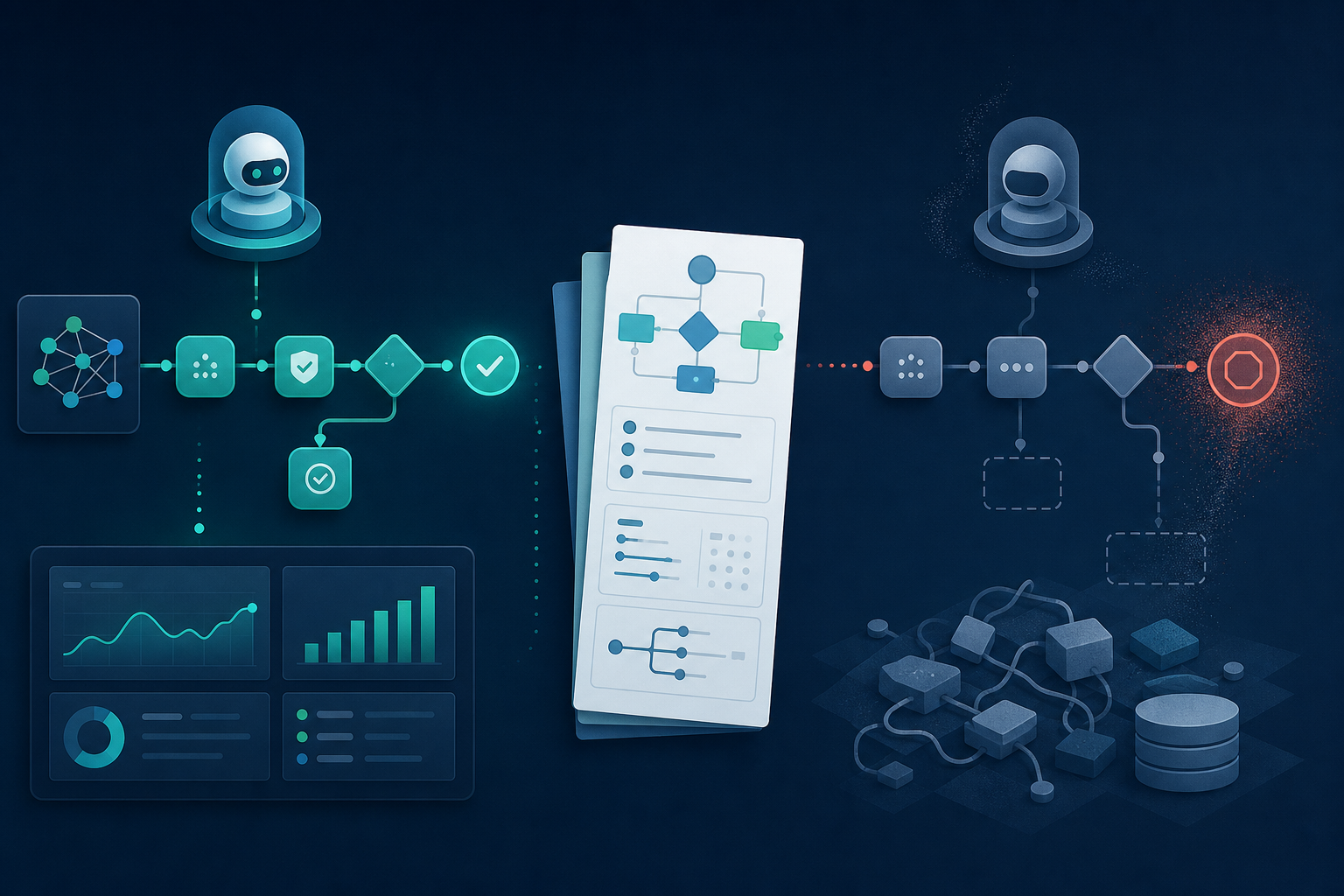
Why doesn't my second AI workflow work as well as the first?
Because the first one was never actually a repeatable process. It was a specific set of judgment calls, made mostly by one engineer, that happened to work on the easiest problem you had. Nobody wrote those calls down, so there was no "it" to copy. You didn't build a system. You got lucky once, competently.
This is the mid-year moment a lot of teams are in right now. You shipped a pilot earlier in the year, it's in production, it works, and leadership is asking the obvious next question: what do we scale next? The honest answer, if you're being straight with yourself, is that you don't know yet, because you never wrote down why workflow one worked in the first place.
The pattern, named directly
Here's how it usually goes. A team picks its first AI workflow, and (dry aside, but true) it's always the easy one: highest volume, lowest ambiguity, the task where a human was basically doing pattern-matching on structured inputs all day. Invoice categorization. Intake triage. Document extraction where the documents all look the same. You ship it, it works, everyone celebrates, and rightly so, that's a real win.
Then someone says "great, let's do the same thing for [harder, messier process]" and it falls apart. Not because the model is worse. Because the thing that made workflow one work wasn't the model. It was a pile of decisions that lived in one engineer's head and never made it into a doc, a config file, or anything another human could read.
What actually made workflow one work (and why none of it got written down)
Three things carry a production AI workflow. None of them are the prompt.
Decision logic. When does the model auto-execute, and when does it defer to a human? That threshold isn't arbitrary, someone tuned it, probably by trial and error, watching false positives roll in and adjusting confidence cutoffs until the error rate felt acceptable. That tuning process is valuable. If it's not written down, the next engineer either has to redo it from scratch or guess.
Data validation rules. What gets rejected before it ever reaches the model? Every working production workflow has a bouncer at the door: malformed inputs, out-of-scope requests, edge cases that got hard-coded out after someone got burned once. That list of rejections is usually the result of real incidents. If it lives in one person's memory instead of a validation layer everyone can see, you're one Slack thread away from losing it.
Failure recovery. Not "what happens when the model is down," which is a boring infrastructure question. What happens when the model is wrong? Confidently, plausibly wrong. Workflow one almost certainly has a quiet correction loop: a human review step, a downstream check, something that catches the bad output before it does damage. That loop is usually informal, unglamorous, and completely undocumented, which means it's the first thing that fails to transfer to workflow two.
If any of this sounds like "vibes, but they worked," you're not wrong, and we've written before about why "seems fine" isn't a metric you can build a second workflow on top of.
The PolicyFlow example: speed that only holds up if it's legible
PolicyFlow is our own proof point here, and it's worth being specific instead of hand-wavy about it. One senior engineer plus an AI co-pilot shipped, in three months, what would've taken a four-person team a year. That's not a marketing number, that's a staffing and timeline comparison we can point to directly.
But here's the part that matters for this post: that speed only survives contact with a second project if the judgment calls behind it are legible to somebody who isn't the original engineer. If the confidence thresholds, the input validation rules, and the human-review triggers all lived in one person's head, PolicyFlow's second workflow would take the same three months all over again, or worse, because now there's production traffic depending on it and less room to experiment. The entire value of that 4-person-team-in-3-months result is that it's reusable, not just fast once.
Why this is the mid-year question, specifically
Half a year in, most teams shipping AI aren't asking "does this work." They already know it works, they've got the pilot live and the metrics to prove it. The question on the table now is a scaling decision: build workflow two, hire for it, or pause. And the uncomfortable truth is that you cannot scale a workflow you never documented. You can only re-discover it, slower, with more people in the room and less patience for the trial-and-error that got you here the first time.
This is also where headcount stops being the answer. Throwing another engineer at workflow two doesn't fix the documentation gap, it just means two people don't understand the system instead of one. We've made that case at length in why headcount is the wrong lever for scaling AI workflows, and it holds here: more hands doesn't create decision logic that doesn't exist yet.
The fix: an evaluation harness and a decision log, not governance theater
An evaluation harness and a written decision log sound like compliance homework, and in a lot of orgs they get treated that way, bolted on after the fact to satisfy an audit. That's backwards. The real function of that artifact is to turn "one engineer knows how this works" into "this is how we build the next one." It's the difference between institutional knowledge and a single point of failure with a laptop.
Concretely, that means writing down the confidence thresholds and why they're set where they are, documenting the validation rejections and the incidents that caused each one, and turning the informal review loop into an explicit quality gate with a defined pass/fail. This is the substance of what an AI Enablement Retainer exists to build: not a one-time deliverable, but ongoing evaluation and governance discipline as your AI footprint grows past one workflow.
For startups, this is about not re-inventing the wheel every time you ship a feature. For SMBs and mid-market teams, it's about not being one resignation letter away from losing your only working AI system. For enterprise, it's an audit problem the moment a regulator, a new CISO, or an internal review asks how workflow one's decisions actually get made, and "ask the guy who built it" is not an answer that satisfies NIST AI RMF or ISO 42001. If workflow two is already on your roadmap, it's worth reading why your second AI workflow needs governance the first one never had before you start building.
Where to go from here
If you've got a working first workflow and no idea which parts of it are actually reusable, that's exactly the gap worth closing before you write a line of code for workflow two. Download our case study on how PolicyFlow's decision logic and validation patterns got documented and turned into a reusable pattern, not a one-off. Then, if you want a second set of eyes on your own setup, book an AI Opportunity & Readiness Sprint: two weeks, fixed fee, and you'll leave with a map of what's actually replicable in your first workflow before you build a second one blind.
Frequently asked
Why doesn't my second AI workflow work as well as the first?
Because the first workflow was never actually a repeatable system—it was undocumented judgment calls made by one engineer that happened to work on an easy problem. Without written decision logic, validation rules, and failure recovery procedures, there's nothing to copy when scaling to the second workflow.
What gets left out when teams scale from workflow one to workflow two?
Teams typically skip documenting the three things that actually carried their first production workflow: decision logic (when to apply the AI), validation rules (what counts as correct), and failure recovery (what happens when it breaks). These live in one engineer's head instead of in docs, configs, or readable formats.
Why is the first AI workflow always the easiest one?
Teams naturally pick high-volume, low-ambiguity tasks for their first AI win—invoice categorization, intake triage, or document extraction with consistent formats. These are pattern-matching problems on structured inputs where success is easier to achieve, but also easier to leave undocumented.
Building AI into real operations is what we do.
Start a conversation