Why Headcount Is the Wrong Lever for Scaling AI Workflows
Teams scaling AI workflows default to hiring reviewers and ops coordinators instead of engineering the routing and exception logic between agent output and human decision. This piece names that coordination tax, uses PolicyFlow as proof it can be engineered away, and gives readers a diagnostic to run before their next hire.
The Tell: You're Hiring Faster Than You're Shipping
If your H1 pilot worked and your H2 plan is "hire two ops coordinators and a reviewer," stop. That's not a scaling plan. That's a symptom.
We've watched this pattern enough times to name it: a team ships one AI workflow, it works, leadership gets excited, and the instinct is to throw people at workflow two, three, and four. A reviewer here. A prompt babysitter there. Someone to chase down approvals when the agent flags an exception. Headcount goes up. Shipping velocity does not. Six months later the team has more people and the same number of production workflows they started with, because every new hire is absorbed into coordination work instead of building the next thing.
Hiring faster than you're shipping isn't a growth signal. It's a tell that nobody engineered the layer between agent output and human decision, so you're staffing around a gap instead of closing it.
What Coordination Work Actually Is
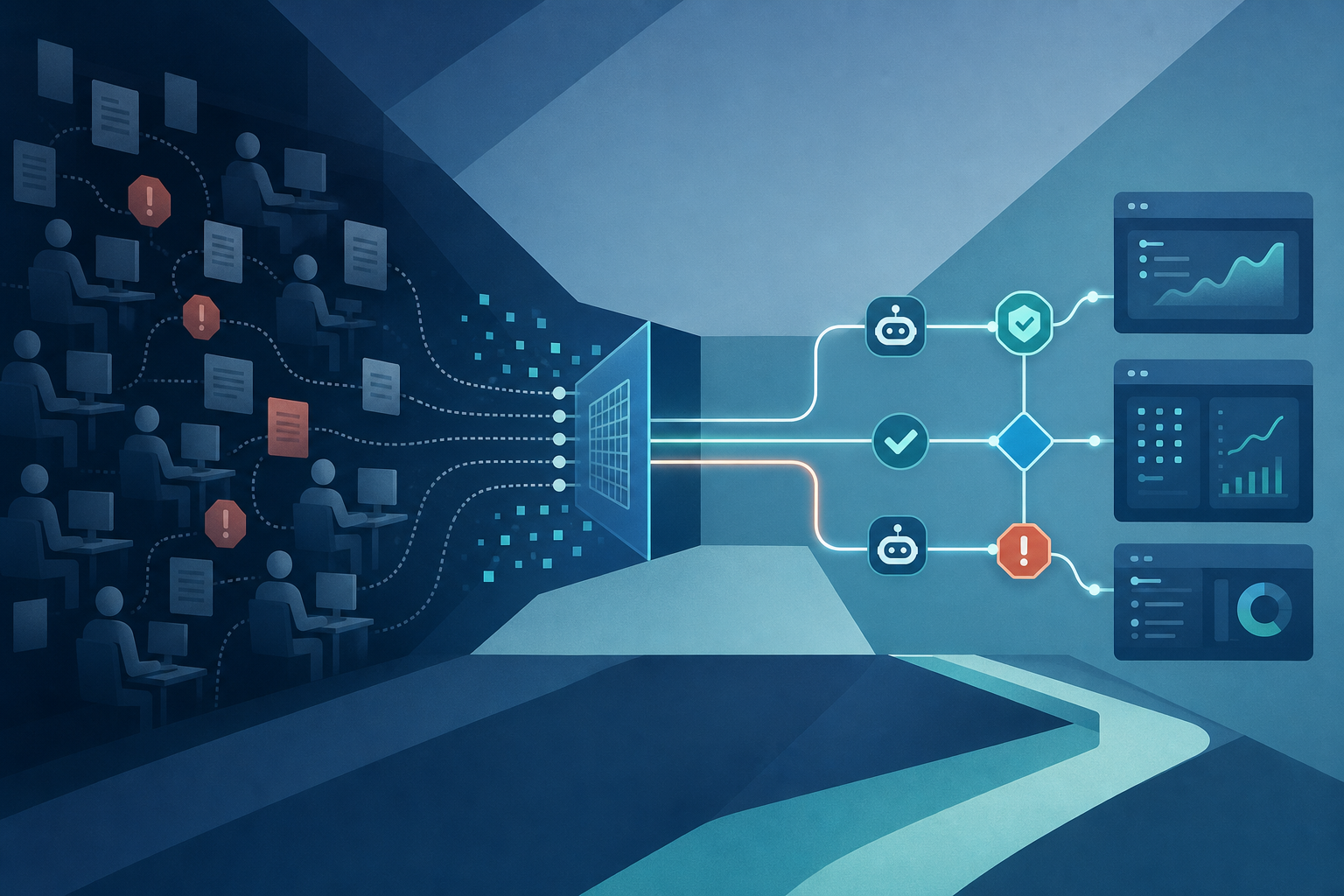
Coordination work is the invisible layer that eats headcount without producing output. It's not the AI doing the task, and it's not a human making a real judgment call. It's the stuff in between:
- Routing an agent's output to whichever person is supposed to review it today
- Chasing someone down because an approval has sat in a queue for two days
- Re-running a step that failed silently, because nobody built retry logic
- Reconciling exceptions by hand because there's no rule for what counts as an exception
Here's the part that breaks most scaling plans: coordination work scales with headcount, not with workflow volume. Add a workflow, and if the routing and exception-handling logic isn't built, you don't get more output, you get more people doing the same kind of manual traffic-directing you had before, just across a wider surface area. It's the org chart equivalent of tech debt. You don't see it in the pilot. You feel it the second you try to run a second or third workflow through the same team.
If this sounds familiar, you've probably already lived why your second AI workflow is more dangerous than your first: the risks and the coordination tax show up together, because both come from skipping the same engineering step.
The Proof: What Happens When You Engineer the Layer Instead of Staffing It
PolicyFlow is the clearest example we have. It's an AI-powered insurance data intake system, and the build was one senior engineer plus an AI co-pilot. Three months. A traditional approach, the kind that staffs coordination work with people, would've taken a 4-person team about 12 months to hit the same production outcome.
That's not a productivity anecdote. That's what happens when the routing logic, the exception handling, and the review gates are built into the workflow instead of bolted on with hires. One engineer could carry it because the system did the coordination: deciding what needed human eyes, flagging genuine exceptions, and letting everything else move without a person in the loop. Nobody was manually deciding who reviews what. The workflow decided.
Compare that to a team that scaled PolicyFlow the default way: one reviewer per workflow, one ops person to track SLA on approvals, one more hire when volume doubled. Same output ceiling, four times the headcount, four times the coordination overhead, and none of it shipping anything new.
Two Teams, Same AI, Very Different H2
Picture two companies six months after their first AI pilot lands.
Team A hires. A reviewer to check every agent output, because trust is still low. An ops coordinator to route exceptions, because nobody built rules for what's actually an exception. Someone semi-informally babysitting prompts because outputs drift and nobody's watching quality systematically. Headcount grows in a straight line with workflow count. This team looks busy. It is not compounding.
Team B builds an evaluation harness once, defines quality gates once, and lets the system route only genuine exceptions to a human. The rest gets logged, governed, and shipped without a person touching it. When Team B adds a second and third workflow, headcount barely moves, because the coordination logic was built to be reused, not re-staffed. If you want a gut check on which team you resemble, why some teams are shipping their third AI workflow while others are still stuck on their first is worth fifteen minutes with your own metrics next to it.
The difference isn't talent. It's whether the coordination layer is a system or a headcount line.
The Diagnostic: Run This Before You Post Another Job Req
Before you approve a hire to "support" your AI workflows, run this exercise. It takes an afternoon.
- Map every step between an agent's output and a final decision. Literally list who touches it and why.
- For each human touchpoint, ask: does this step exist because it requires judgment, or because nobody built the routing/eval logic yet? Be honest. "We haven't gotten to it" is a real answer, and it's the useful one.
- Count the steps that fall into the second bucket. That's your coordination tax, and it's the thing a hire will paper over, not fix.
- Check whether "seems fine" is your current quality bar. If nobody can point to a metric that decides pass/fail, you don't have a quality gate, you have a vibe, and that's exactly what forces a human into every loop. This is worth fixing before it's not a metric.
If most of your review steps land in bucket two, hiring won't fix your H2. It'll just make the coordination tax more expensive and harder to unwind later.
The Fix Is Process, Not Magic
None of this requires a bigger model or a smarter agent. It requires building the layer most teams skip: evaluation harnesses that score output quality automatically, quality gates that decide what actually needs a human, and routing logic that gets genuine exceptions to the right person without anyone chasing anything down.
That's specifically what a Pilot-to-Production Build closes: the gap between a workflow that works in a demo and one that runs at volume without a proportional headcount curve. And once that layer exists, it needs maintenance as your AI footprint grows, new edge cases show up, models get swapped, governance requirements tighten. That's the ongoing work an AI Enablement Retainer covers: keeping the eval and governance layer current instead of letting it rot while you staff around new gaps.
If you're staffing coordination work right now, or about to, that's the fastest way to burn an H2 budget without shipping more than you did in H1.
Do This Before You Write the Job Req
Run the AI Opportunity & Readiness Sprint. In two weeks, we map exactly where your team is doing coordination work by hand, whether it's judgment or just unbuilt logic, and hand you an executable plan to automate it. Two weeks is faster than a hiring cycle, and it answers the question a new hire can't: whether you need a person there at all.
Frequently asked
Why does hiring more people not solve AI workflow scaling?
Coordination work scales with headcount, not workflow volume. New hires get absorbed into manual coordination tasks like routing, approvals, and exception handling instead of building new workflows. Without engineered routing and exception logic, adding people doesn't increase shipping velocity.
What is coordination work in AI workflows?
Coordination work is the invisible layer between agent output and human decision-making. It includes routing outputs to reviewers, chasing approvals, running failed steps manually, and reconciling exceptions by hand—tasks that consume headcount without producing new workflow output.
How can teams avoid the coordination tax when scaling?
Engineer the routing and exception logic between agent output and human decision-making instead of staffing around the gap. This requires building retry logic, rule-based exception handling, and intelligent routing systems rather than hiring coordinators to manage these tasks manually.
Building AI into real operations is what we do.
Start a conversation