Why Your Second AI Workflow Is More Dangerous Than Your First
The real mid-year AI decision isn't which workflow to scale next, it's whether your first production workflow is a system or just one engineer's tribal knowledge, and this piece makes the case for evaluation harnesses (and the PolicyFlow proof point) as the fix.
The Question Nobody Asks Before Shipping Workflow #2
Here's the mid-year question that actually matters: not "what do we scale next," but "could someone other than the person who built our Q1 workflow debug it at 2am, using only the eval suite and the runbook?"
If you hesitated, you don't have a production AI workflow. You have tribal knowledge with a nice UI on top.
That sounds harsh. It's meant to. We've watched this exact failure mode play out enough times to know it's not a hypothetical: one engineer ships something that works, everyone celebrates, and six months later that same engineer is the only person who knows which prompts drift under load, which edge cases silently fail into a human queue, and which vendor outage takes the whole pipeline down. That's not a production system. That's a bus factor of one wearing a demo that went well.
Why Is Scaling AI Workflows Riskier Than the First One?
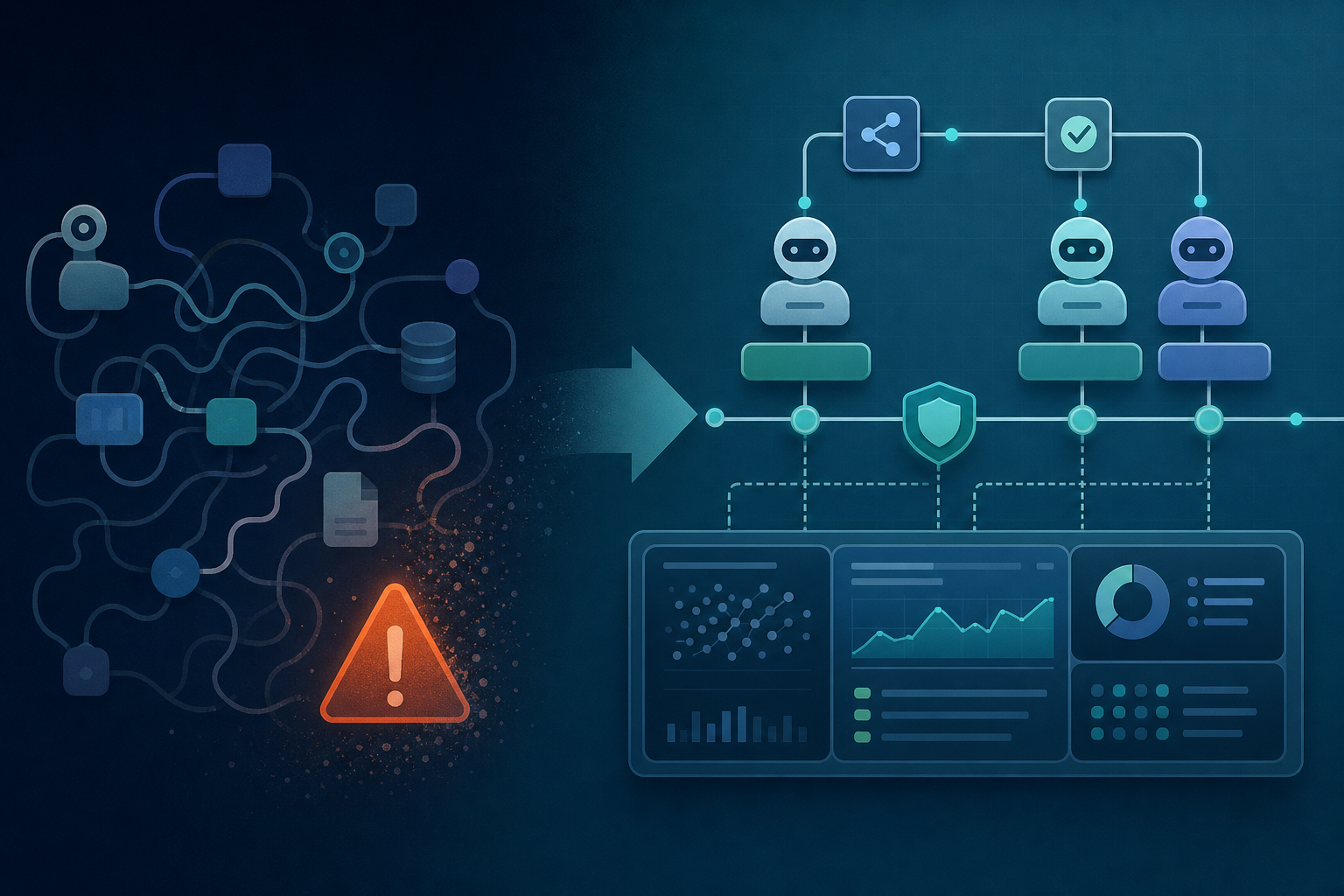
Because the risk doesn't add, it multiplies. Workflow #1 with one person holding all the failure modes in their head is fragile but contained. Add workflow #2, and that same person is now triaging failure modes across two systems that were never built to share evaluation criteria. There's no common definition of "this output is wrong" between the two. No shared runbook. No consistent way to tell if a failure in workflow #2 is a new problem or the same drift pattern that's been quietly breaking workflow #1 for weeks.
You didn't double your exposure. You compounded it, and you did it before you had time to hire your way out.
This is the trap we cover in why your second AI workflow needs governance the first one never had: the assumption that whatever got workflow #1 to production will just... work again. It won't, because workflow #1 succeeded on the back of one person's judgment, and judgment doesn't scale. Systems do.
The Tribal Knowledge Test
Run this test on your Q1 workflow right now, not after you ship workflow #2:
- Can someone other than the builder read the eval results and know whether the system is degrading or just noisy?
- Is there a runbook, or is the runbook "call Dave"?
- If your AI vendor has an outage tonight, does anyone besides the original engineer know what breaks downstream?
If the honest answer to any of these is "only one person knows," you've found your real mid-year priority. It's not workflow #2. It's turning workflow #1 from a person into a process.
Evaluation Harnesses Are How Tribal Knowledge Becomes Institutional Knowledge
The fix isn't more headcount. Hiring a second engineer to shadow the first doesn't codify anything, it just gives you two people with tribal knowledge instead of one, and no guarantee they agree on what "good" looks like.
The actual fix is boring, in the best way: build an evaluation harness that encodes the failure modes your one engineer currently holds in their head. Which inputs cause hallucination. Which categories need human review no matter what the model says. Which outputs are correct but for the wrong reason, and will eventually break in a way that looks fine until it doesn't. Every one of those is currently a fact about your system that lives in exactly one skull. An eval suite turns it into a repeatable, automated check that runs whether or not that person is in the room, on vacation, or gone.
Quality gates do the same thing for deployment: a workflow doesn't ship a change to production until it clears the bar the harness defines. That's not bureaucracy. That's the difference between a system you can hand off and a system you're quietly hoping never gets handed off, because nobody else could run it.
We've written before about why AI pilots stall before production, and the pattern rhymes here: the gap between "it worked in the demo" and "it works when I'm not watching it" is exactly where evaluation infrastructure earns its keep.
What This Looks Like in Practice: PolicyFlow
PolicyFlow is the proof point we keep coming back to, because the math is genuinely good: one senior engineer plus an AI co-pilot shipped in three months what would have taken a four-person team a year. That's not a hiring story. That's a systematization story.
But here's the part that matters for the mid-year decision: that model, one engineer plus AI co-pilot moving faster than a full team, only holds up past workflow #1 if the knowledge that made workflow #1 work gets pulled out of that engineer's head and put into something durable. An eval suite. A governance process. A set of quality gates that don't care who's on call.
Staff up without doing that, and you haven't scaled the PolicyFlow model. You've just hired more people to hold more tribal knowledge, which is the same fragility with a bigger payroll.
The Real Mid-Year Decision
So before you greenlight workflow #2, ask the question that actually decides whether you're ready: is what you shipped in Q1 a system, or is it a person? If it's a person, the fix isn't a backfill req, it's building the evaluation and governance layer that makes the knowledge portable, auditable, and boring in the way production infrastructure should be boring.
This is precisely what an AI Enablement Retainer is built for: ongoing evaluation, governance, and iteration as your AI footprint grows from one workflow to several, instead of hoping the one person who understands workflow #1 never takes a vacation, never gets recruited away, and never gets hit by a bus (metaphorically, please).
If you're weighing workflow #2 right now, run the PolicyFlow math against your own team. Download the PolicyFlow case study and use it to run your own half-year gut check: could someone else debug your Q1 workflow without you in the room? If the answer is no, that's your actual mid-year priority, before workflow #2 ever gets a ticket.
Frequently asked
Why is scaling a second AI workflow riskier than the first?
Risk multiplies rather than adds. While workflow one with tribal knowledge is fragile but contained, adding workflow two creates compounded exposure. Two systems lack shared evaluation criteria, common definitions of failure, or consistent runbooks, making it impossible to distinguish new problems from existing drift patterns.
What is the key question to ask before shipping a second workflow?
Ask whether your first production workflow is a true system or just tribal knowledge. Can someone other than the original engineer debug it at 2am using only the eval suite and runbook? If not, you have a bus factor of one, not a production system.
What is the solution to preventing scaling failures?
Implement evaluation harnesses and governance frameworks before scaling. These establish shared evaluation criteria, consistent runbooks, and standardized failure definitions across workflows, enabling proper production systems rather than engineer-dependent demonstrations.
Building AI into real operations is what we do.
Start a conversation