Why AI Pilots Stall Before Production
The gap between a working demo and a system your team trusts on a Monday morning is where most AI projects quietly die. Here's how we close it.
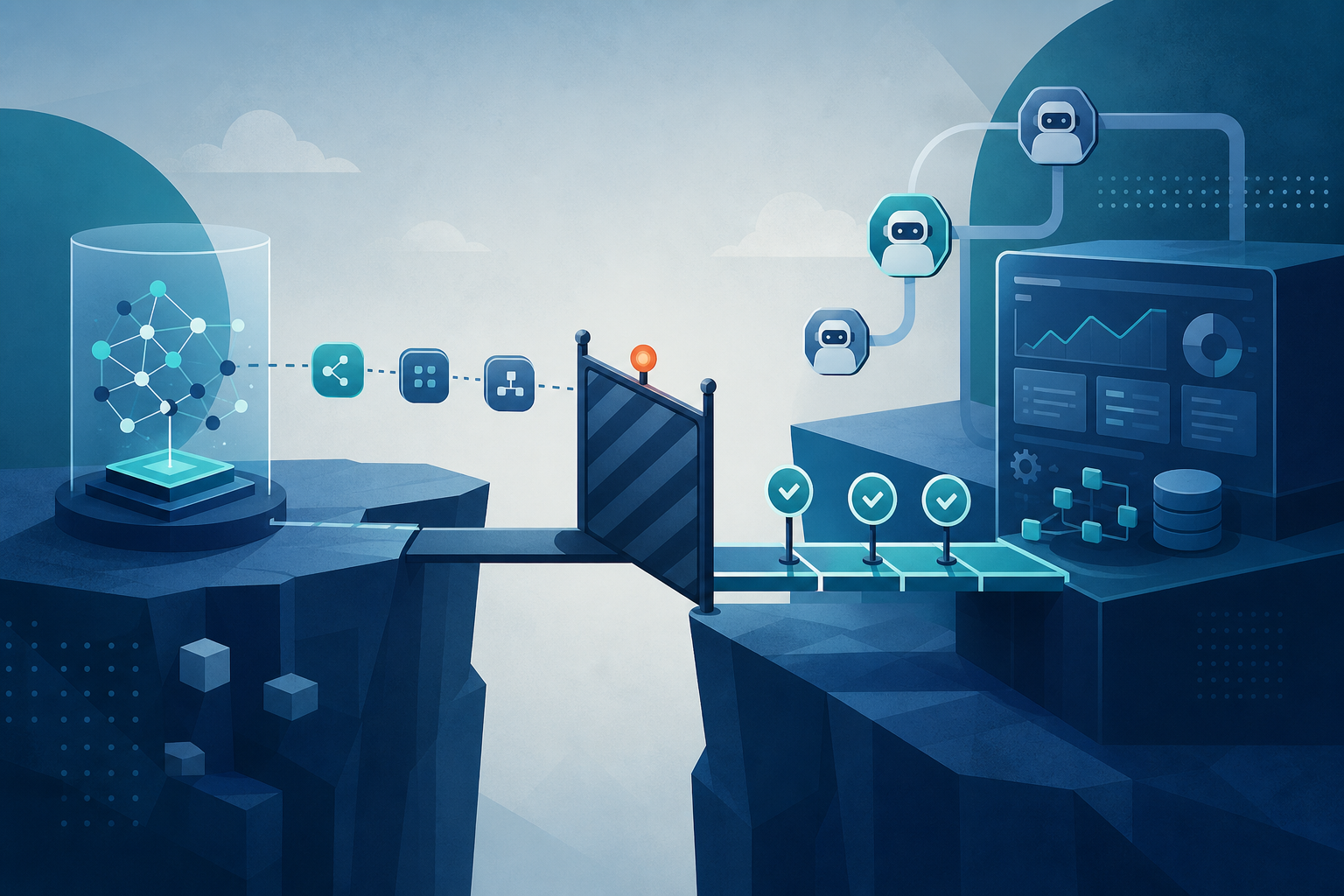
Everyone has seen the demo. A model reads a messy spreadsheet, answers a hard question, drafts the email. It looks like magic in the room. Then it goes nowhere.
We've built seven companies and shipped AI into other people's operations, and the pattern is consistent: the distance between an impressive pilot and a system your team actually relies on is mostly unglamorous engineering. That's where projects stall.
The demo optimizes for the wrong thing
A pilot is judged on its best-case output. Production is judged on its worst-case output. Those are different problems. A workflow that's right 80% of the time is a great demo and a liability on a Monday morning, because the 20% lands on a person who now has to catch it.
Closing that gap means designing for the failure cases first: what happens when the input is malformed, when the model is unsure, when the answer is wrong and nobody notices.
Three things production needs that a pilot skips
- A confidence boundary. The system has to know when it doesn't know, and route those cases to a human instead of guessing confidently.
- An audit trail. Every decision needs to be reconstructable after the fact — what came in, what the model saw, what it did.
- An owner. Someone on your team has to be able to run, monitor, and adjust it without us in the room. If it only works while the builders are watching, it isn't done.
Building companies taught us what consulting firms never learn: if it doesn't ship, it doesn't count.
Design for the boring 20%
The teams that get AI into production aren't the ones with the flashiest models. They're the ones who treated the unglamorous 20% — validation, fallbacks, observability, hand-offs — as the actual product. The demo was never the hard part.
If you've got a pilot that impressed everyone and then quietly stopped, that's not a failure of the idea. It's usually a sign nobody designed the path to Monday morning. That path is buildable, and it's most of the work.
Frequently asked
Why do AI pilots fail to reach production?
The gap between a working demo and a system your team trusts in production is where most AI projects die. Pilots are judged on best-case output while production requires handling worst-case scenarios. Teams that succeed treat the unglamorous 20% as the actual product rather than optimizing for demo performance.
What's the difference between how pilots and production are evaluated?
A pilot is judged on its best case output, showcasing optimal performance under ideal conditions. Production systems are judged on their worst case output—how they handle edge cases, failures, and messy real-world data that determines whether teams trust the system on a Monday morning.
Building AI into real operations is what we do.
Start a conversation