Why Your Second AI Workflow Needs Governance the First One Never Had
Your first AI workflow shipped safely because a human watched every output by hand, not because governance was working. This post breaks down why that approach collapses on workflow #2 and what a real evaluation and governance layer (harness, data boundaries, named owners) actually looks like, using PolicyFlow as proof that guardrails baked in from day one are what make speed possible, not what slows it down.
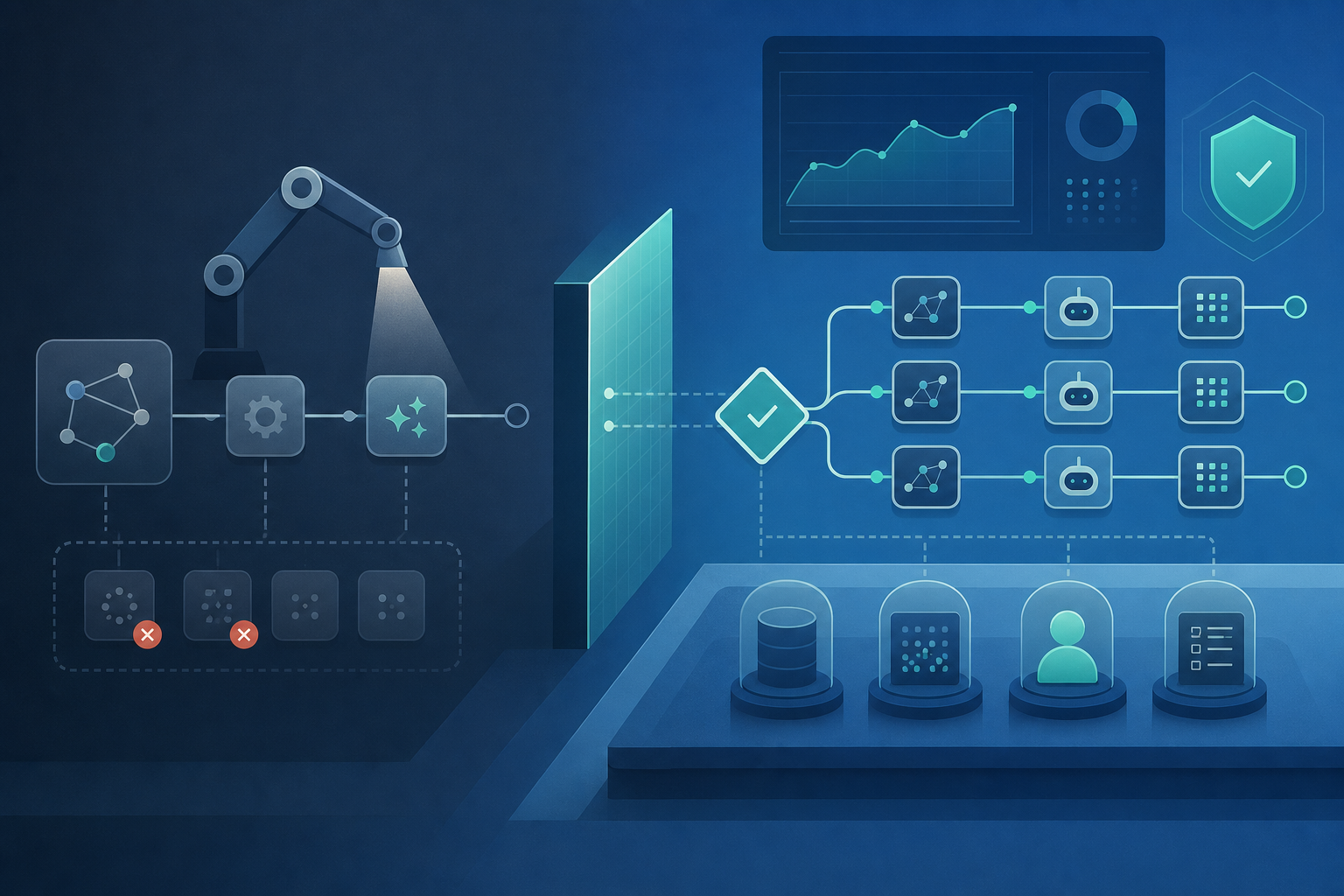
Your First Workflow Didn't Prove Governance Was Optional
It shipped fine. Someone on the team read every output for the first few weeks, caught the weird ones, tweaked the prompt, moved on. No eval harness, no documented data boundaries, no named owner for failures. It worked, so the team quietly concluded governance was overhead for later, maybe never.
That's not evidence governance is optional. That's a demo with a babysitter. One person eyeballing every output is a review process that doesn't scale past a headcount of one, and it was never really being tested: small surface area, low stakes, a human safety net underneath every single run. Call it what it is, because the moment you call it "our AI process," you've mistaken a lucky first bet for a system.
Why Workflow #2 Is Where the Babysitter Model Breaks
The second workflow rarely resembles the first. It pulls from more data sources. It hits edge cases the first one never saw, because the first workflow was scoped narrow on purpose (that's why it was first). And critically: nobody has time to read every output anymore, because now there are two workflows running, plus whatever the team is doing to keep the business moving.
This is precisely the moment a lot of teams are sitting in right now, mid-year, reviewing what the first half actually produced and deciding what earns a bigger bet in the second half. The instinct is to scale the thing that worked. The trap is scaling it the same way it shipped: without a harness, without boundaries, without an owner. What was manageable risk on workflow #1 becomes rework on workflow #2, because a bad output that nobody catches for two weeks doesn't just cost you that output. It costs you the audit, the rollback, and the trust conversation with whoever green-lit the budget.
We wrote about this pattern in detail in Shipping Workflow One Doesn't Teach You Workflow Two, and the short version holds: the skills that got you to a working pilot are not the skills that get you to a portfolio of them. If your team is already watching review cycles balloon, Your First AI Workflow Shipped. Your Second One Is Drowning in Review Cycles walks through exactly why that happens and where the time is actually going.
What a Real Governance Layer Looks Like (Not a PDF)
When we say "governance," we don't mean a policy document that lives in a shared drive and gets referenced once, during the incident review. We mean three concrete things, built into the workflow, not attached to it after something breaks:
An evaluation harness with quality gates. A defined set of test cases, golden outputs, and thresholds that run before a change ships and on a schedule after it's live. Not "someone will notice if it's off," but a gate that fails loudly if accuracy, format, or tone drifts outside bounds you set on purpose.
Clear data boundaries. What's in the RAG scope and what isn't. What the model can reach through MCP and what it explicitly cannot touch: customer PII, financial systems, anything that turns a bad output into a bad decision downstream. This is where CISOs and CTOs should be looking first, not last, because excessive agency (the model doing more than the workflow needs it to) is one of the most common ways a working pilot turns into an incident report.
A named owner for failures. Not "the team," a person. Someone whose job includes reviewing what the eval harness flags, deciding what ships and what gets pulled back, and closing the loop so the same failure mode doesn't reappear in workflow #3.
That's the whole framework. It's not exotic. It's the difference between a system and a lucky run.
PolicyFlow: Guardrails Baked In, Not Bolted On
Here's what it looks like when this is done from day one instead of retrofitted after a second workflow goes sideways. On PolicyFlow, one senior engineer plus an AI co-pilot shipped in three months what would have taken a four-person team roughly twelve months, an insurance data intake workflow with real production stakes.
That speed didn't come from skipping guardrails to move fast. It came from building the evaluation checks and data boundaries into the workflow from the start, so every iteration had a gate to pass instead of a human reading every line by hand. Governance wasn't the tax on that speed. It was a structural part of it: the eval harness caught regressions before they shipped, which meant the team spent its time building the next improvement instead of re-litigating whether the last one was safe.
That's the reframe worth sitting with. Governance isn't what slows down workflow #1. It's what makes workflow #3, #4, and #5 possible without re-earning trust from zero every single time.
Building This Once Your AI Footprint Is Growing
If you're past the first pilot and deciding what to scale next, this is exactly the mid-year decision point where the evaluation gap either gets addressed or gets expensive. A governance layer isn't a one-time setup, it needs to evolve as your data sources multiply and your workflows compound, which is a different problem than shipping the first one. That ongoing work, ie tuning the eval harness, expanding data boundaries as new sources come online, keeping an owner accountable as the team grows, is what an AI Enablement Retainer is built for: not a one-off build, but the mechanism that lets your AI footprint grow without every new workflow starting its trust conversation over. For a broader look at why pilots stall before they ever get this far, Why AI Pilots Stall Before Production is worth a read alongside this one.
What This Costs You If You Skip It
The honest answer: you won't know until workflow #2 or #3 produces a bad output nobody catches for two weeks, and by then you're not measuring the cost of governance, you're measuring the cost of not having it. That's a worse number, and it's the one that shows up in a postmortem instead of a planning doc.
If you want to see what shipping with guardrails built in actually looked like end to end, timeline included, download the PolicyFlow case study and then book an AI Opportunity & Readiness Sprint. Two weeks, fixed fee, and you'll walk away knowing exactly what your evaluation and governance gap costs before it costs you workflow #2.
Frequently asked
Why does manual review work for the first AI workflow but fail for the second?
Manual review on workflow one worked because one person could eyeball every output with small surface area and low stakes. Workflow two hits edge cases, pulls more data sources, and teams lack capacity to manually review all outputs anymore. This unmanaged risk scales into rework and audit costs.
What governance elements prevent the second workflow from failing?
Real governance requires an evaluation harness, documented data boundaries, and named owners for failures. These guardrails baked in from day one make speed possible rather than slowing it down, preventing the rework and rollback costs that come from undetected bad outputs.
Building AI into real operations is what we do.
Start a conversation