Your First AI Workflow Shipped. Your Second One Is Drowning in Review Cycles. Here's Why.
Your first production AI workflow succeeded because it was small enough to skip every hard organizational question. Your second one is stalling because those questions are now unavoidable, and the fix is instrumented feedback loops and a pre-agreed quality gate document, not a rebuilt governance framework. This post explains the specific failure modes (evaluation limbo, missing eval harnesses, security gaps that compound across workflows) and what to do about them before workflow two enters review.
One senior engineer, three months, production. That's PolicyFlow. One engineer with an AI co-pilot, roughly 80% lower cost than a traditional build, shipped. That's SoloStream. Both of those outcomes are real, and if you've hit a comparable first win, congratulations, you've cleared a bar most teams never reach.
Now here's the part nobody talks about at the post-launch retro: your second workflow is stuck. Not because the model is bad. Not because your team lost its edge. Because the first workflow succeeded in a vacuum, and the vacuum just ran out.
Why the First One Worked (and Why That's Partly the Problem)
The first production AI workflow succeeds for a specific, underappreciated reason: it was small enough to sidestep every unanswered organizational question at once. One use case. One primary stakeholder who could make the call on "good enough." One failure mode that was obvious enough to catch manually if something went wrong.
Nobody had to define what a regression looks like because there was only one version to compare against. Nobody had to agree on a rollback threshold because the blast radius was contained. Quality was whatever the person closest to the output said it was, and that person was usually in the same Slack channel as the engineer who built it.
That's not a governance model. It's a favorable set of initial conditions.
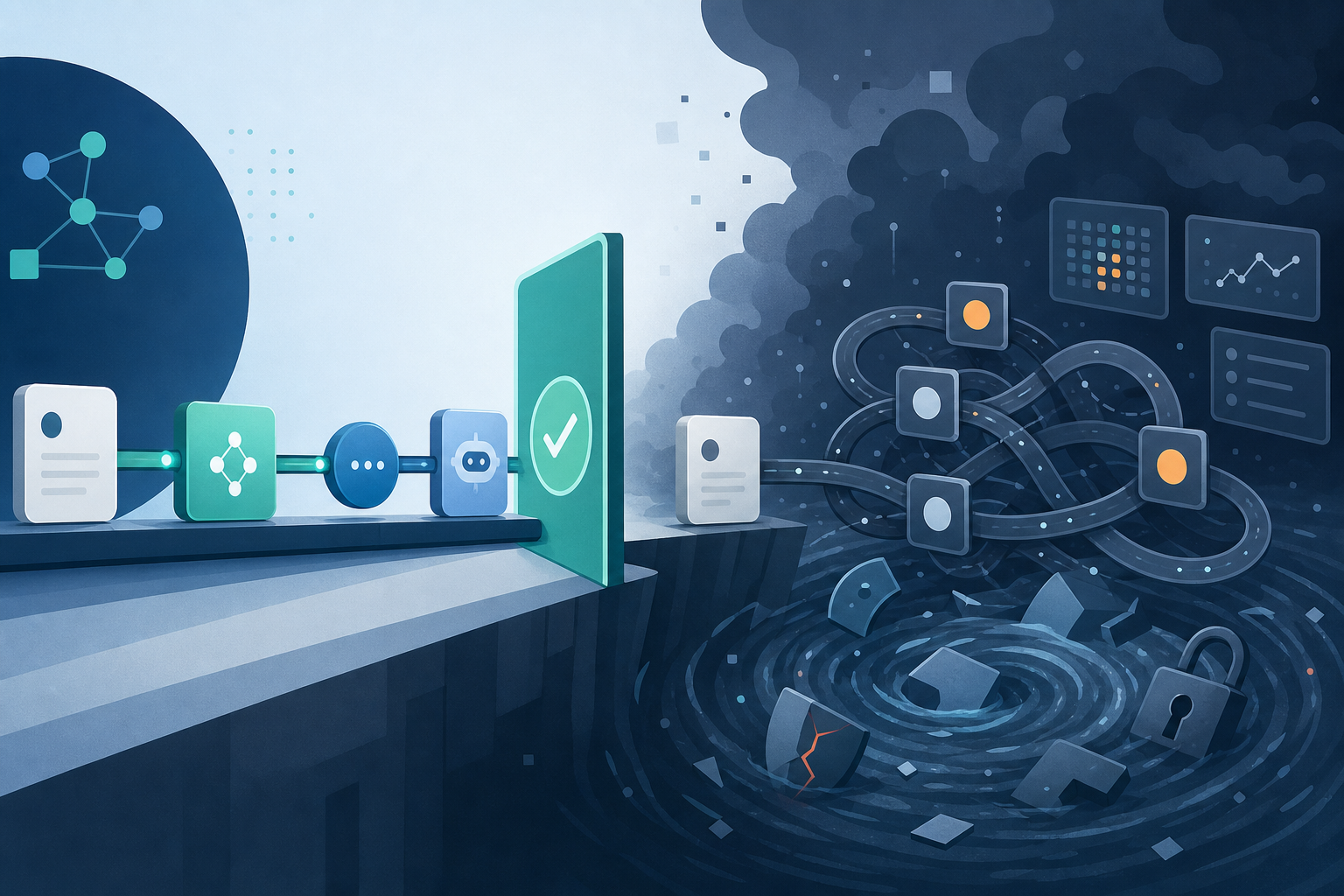
The second workflow surfaces every question the first one let you skip, simultaneously, at review time, in front of stakeholders who each brought a different informal bar. Who owns quality now that this touches two teams? What counts as a regression when the output is more subjective? Which failure mode triggers a rollback versus a hotfix versus a monitoring alert? If your answers to those questions don't exist in writing before the build starts, you're not in a governance gap. You're in evaluation limbo, and the calendar cost of that limbo will exceed everything you spent on workflow one.
The most expensive mistake teams make at this stage is responding to evaluation limbo by rebuilding their governance framework from scratch. Don't. The framework isn't what's missing.
What's Actually Missing: An Instrumented Feedback Loop
A production AI workflow without instrumented feedback is a workflow you cannot safely replicate. Full stop.
By "instrumented," I mean specific things: user signal logging (thumbs-down, correction events, escalations to humans), output sampling with a reviewable trail, latency and cost telemetry, and at least one quality gate threshold you wrote down before launch. If you don't have those, you have a workflow that works today and a feeling that it works. Those are not the same thing when a CISO asks you to justify expanding it.
Before you spec your second use case, go back and instrument the first one. Define what "working" looks like numerically, not impressionistically. Log the edge cases that reach humans. Build a lightweight eval suite narrow enough to run in CI. That suite is not just a quality control mechanism; it's the scaffolding you'll fork for every workflow that follows.
PolicyFlow shipped this way. SoloStream shipped this way. The reason those outcomes were repeatable isn't magic or exceptional talent, it's that the scaffolding was reusable. When the patterns are already defined, each subsequent workflow is an instance of a known process, not a new negotiation from scratch.
If you're reading this and your first workflow has been in production for a few months, the instrumentation question is urgent. The gap between "it's been running fine" and "we have evidence it's running fine" is exactly what makes reviewers nervous about approving the next one.
Evaluation Limbo Is a Social Problem Wearing a Technical Costume
Here's the dry reality of most stalled second workflows: the model is fine. The infrastructure is fine. The use case is validated. And yet the workflow has been in review for six weeks because three different stakeholders are applying three different informal quality bars, none of which were written down before the build started, and all of which feel completely reasonable to the person holding them.
This is governance theater. It looks like rigor. It generates meeting notes. Nothing ships.
The fix is a quality gate document, written before the build starts, that specifies: pass/fail criteria for the output (numerical where possible), an escalation threshold for human-in-the-loop review, and a named owner who has actual authority to make the call. One document, one owner, pre-agreed criteria.
That document does two things at once. It gives your engineering team a clear target so they're not building toward a moving bar. And it gives your CISO, your compliance reviewer, or your legal team the governance artifact they need to say yes, without requiring a separate documentation effort. You've just collapsed two blockers into one deliverable.
If that sounds obvious, consider how many teams skip it because the first workflow shipped without it. The absence of a quality gate document on workflow one felt fine because the blast radius was small and the feedback cycle was tight. It stops feeling fine the moment a second stakeholder group joins the conversation.
Security Gets Harder to Retrofit as Your Footprint Grows
One workflow touching one data source is manageable with ad hoc controls. You can reason about the prompt surface, the data boundary, and the failure modes in your head, or at least in a single Confluence page.
Two or three workflows, each with different data access patterns, different user populations, and different prompt surfaces, is a different problem. Prompt injection risk, excessive agency, and data boundary violations don't scale linearly with the number of workflows. They compound. An assumption that was safe to make in isolation stops being safe when three agents are operating with overlapping data access and no formal boundary definition.
The time to define your MCP and RAG data strategy is between workflow one and workflow two. Not after workflow three creates an incident that forces the conversation. The cost of retrofitting security architecture across an existing multi-workflow AI footprint is substantially higher than defining it once before you've committed to a second set of patterns.
This is one of the reasons the enterprise teams we work with, CTOs and CISOs who've already shipped something, consistently flag data boundaries as the thing they wish they'd formalized earlier. It's not that the first workflow had a problem. It's that the first workflow taught everyone that these decisions can be deferred, and then the second workflow shows up with a larger blast radius and a tighter timeline.
Define the boundaries now. Fork the pattern later.
What "Scaling" Actually Requires at This Stage
Scaling AI workflows does not mean rebuilding your governance model for every new use case. It means having evaluation scaffolding that's cheap to fork, quality gate documents that can be templated, security boundaries that were defined before you needed to justify them, and someone whose job is to maintain the connective tissue between workflows as the footprint grows.
That last point is where most teams underinvest. The first workflow had a clear owner because it was the only thing happening. The second workflow arrives while the first is still being monitored, and suddenly ownership is ambiguous, which is when evaluation limbo takes root.
The Horizon Two Labs AI Enablement Retainer is built for exactly this inflection point. Not to rebuild what's already working. Not to do a governance audit that generates a report nobody reads. To instrument what shipped, extend the eval harness to the next use case, and give reviewers the artifacts they need to say yes faster. Teams that skip this step spend more calendar time on workflow two than they spent on workflows one through five combined. That is not a hypothetical, it's the pattern we see consistently when teams come to us six weeks into a stall.
The good news: the stall is recoverable. The instrumentation isn't complicated. The quality gate document is two pages. The data boundary definition is a conversation that takes an afternoon and saves months.
But none of it happens automatically, and none of it gets easier the longer you wait. If workflow two is on your current roadmap and you haven't yet instrumented workflow one, that's the first thing to fix, before the spec, before the build, before the review cycle starts.
The Next Step
If you've shipped a first production AI workflow and you're mapping your second one now, two resources are directly useful.
The Pilot-to-Production Playbook covers the evaluation harness structure, quality gate templates, and feedback loop instrumentation that make workflows reusable, not just successful once.
The AI Opportunity & Readiness Sprint is a two-week, fixed-fee engagement that maps your second use case before it stalls: defining quality criteria, scoping the data boundaries, and producing the governance artifacts your reviewers need upfront instead of retroactively.
Both are at horizontwolabs.com. If workflow two is already in your roadmap, the time to do this is before the build starts, not after the sixth stakeholder review that changes nothing.
Frequently asked
Why does the first AI workflow succeed while the second one stalls?
The first workflow succeeds by sidestepping unanswered organizational questions—it's small, has one stakeholder, and obvious failure modes. The second surfaces every skipped question simultaneously at review time, requiring pre-agreed quality gates and instrumented feedback loops that didn't exist before.
What are the specific failure modes that cause workflow two to enter review limbo?
Evaluation limbo, missing eval harnesses, and security gaps that compound across workflows. These emerge because the first workflow avoided defining regressions, rollback thresholds, and quality ownership—informal practices that break when scaling.
What's the fix for workflow two getting stuck in review cycles?
Implement instrumented feedback loops and create a pre-agreed quality gate document before the build starts. This replaces ad-hoc governance with written clarity on who owns quality, what counts as regression, and which failure modes trigger rollback versus hotfix.
Building AI into real operations is what we do.
Start a conversation