You Automated the Easy Decision. The Handoff to Your Human Gatekeeper Is Still the Bottleneck
Teams usually automate the AI use case that demos best, not the one with the biggest human wait-time behind it. Using PolicyFlow as the counter-example, this post shows how to find and fix the real bottleneck: the agent-to-human handoff.
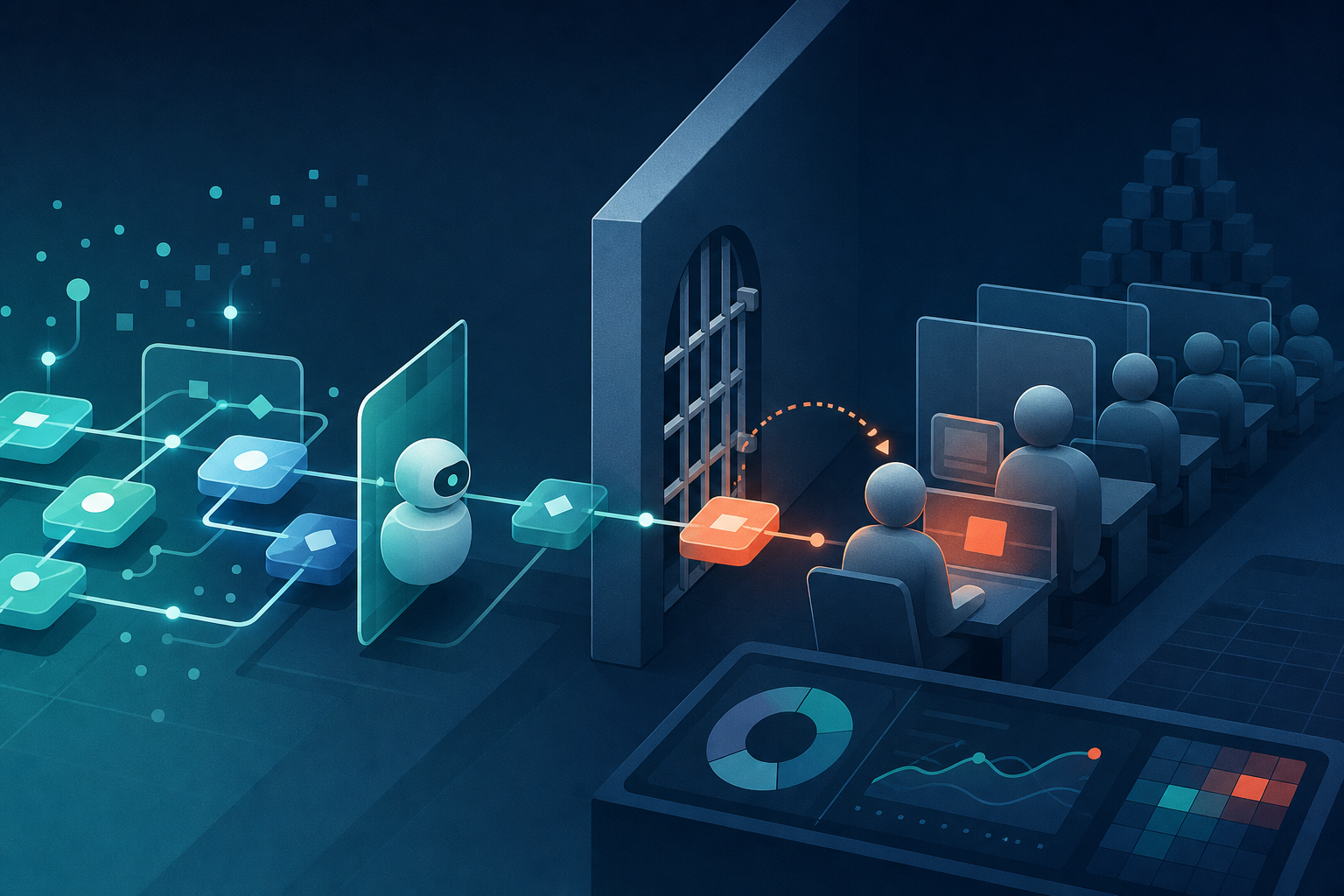
The Task You Automated Was Never the Problem
Here's the pattern, and it's almost boring in how often it repeats: a team picks an AI use case because the inputs are clean and the demo looks great in a Thursday afternoon leadership review. Three months later, the model works fine. The workflow is still slow. Everyone's confused.
The model was never the bottleneck. The handoff was.
Most teams shipping their first AI workflow optimize for what demos well, not what actually clears the queue. An agent that reads structured PDFs and extracts fields looks impressive in a five-minute walkthrough. Nobody in that room is watching what happens next: the extracted output sits in someone's inbox for two days waiting for a human to review, approve, or override it. That wait time was there before you added AI. It's still there now. You just automated the part that was never slow.
Why This Mistake Is Invisible in a Pilot
Pilots run at a fraction of production volume, almost by design. If you're testing with 20 records a week, a human reviewer can absorb the approval step without anyone noticing the queue. The moment you go from 20 records a week to 2,000, that same reviewer becomes the wall. Latency creeps in. Trust erodes, because now people are waiting longer for a decision than they did before the "automation." And the classic failure mode kicks in: someone builds a shadow spreadsheet to route around the bottleneck, and now you're maintaining two systems instead of one.
This is the same accountability gap we've written about before: why most AI pilots die from an accountability gap, not a technology gap. The model performed. The organization around it didn't have a real answer for who signs off, on what, and how fast.
The PolicyFlow Counter-Example
PolicyFlow is the case that makes this concrete. The surface-level pitch would've been "AI reads insurance intake forms." That's the easy-decision version, the one that demos well and ships fast because the inputs (scanned forms, structured fields) are clean.
That's not what actually got built. The real work was redesigning what the human gatekeeper needed to see and approve, not just what the AI could extract. Instead of dumping raw extracted fields into a reviewer's queue and hoping they'd catch errors, the team restructured the approval interface around the reviewer's actual decision logic: what they check first, what triggers escalation, what they need flagged versus what they can rubber-stamp. That redesign is the reason one senior engineer plus an AI co-pilot shipped in three months what a four-person team would've taken twelve months to build. The AI extraction was necessary. It wasn't sufficient. The handoff was the product.
If you want the fuller picture of how a first shipped workflow gets built end to end, how the hotel reminder service shipped its first production AI workflow walks through the same principle in a different domain.
A Diagnostic You Can Run This Quarter
Before you commit budget to next year's AI roadmap, run this on every candidate workflow:
Map the queue on both sides of the task. For the task itself: how long does it take the AI to do its part, start to finish? For the handoff: how long does the item sit waiting for a human to review, approve, or override it, on average, at your actual volume, not pilot volume?
Compare the two numbers. If the human approval step has a longer wait time than the task itself, you've found your real bottleneck. It's not the extraction, the classification, or the summarization. It's the queue behind the human gatekeeper.
Ask what the reviewer actually needs to see. Not what your system happens to output. What decision are they making, and what's the minimum information required to make it fast and defensible? This is usually where teams discover their current UI is built around the AI's output format, not the human's decision logic, which is exactly the gap PolicyFlow closed.
If this step feels underbuilt in your current stack, why your AI pilot breaks on data that "looked fine" when a human did it is worth reading next. It covers the sibling problem: data that passed a human's informal quality bar for years suddenly fails once an agent has to work with it explicitly.
Why This Matters More If You're Answering to a CISO
For enterprise teams, the agent-to-human handoff isn't just a speed problem. It's your audit trail.
Every approval step is a natural checkpoint for excessive-agency controls: what the agent is allowed to do autonomously versus what requires sign-off, and a record of who approved what, when, and on what basis. If you're mapping this against something like the NIST AI RMF or the OWASP LLM Top 10, a well-designed handoff is the control, not a UI nicety bolted on after the fact. A vague "human reviewed it" checkbox doesn't hold up under audit. A handoff designed around specific decision criteria, with a logged rationale, does.
We've gone deeper on this exact failure mode in NIST AI RMF and ISO 42001 won't stop your agent from deleting the wrong records. The frameworks give you a vocabulary for governance. They don't design your approval step for you. That's still an engineering decision, and it's usually the one teams skip because it doesn't show up in a demo.
Where to Look Before You Lock the Roadmap
Budget season means someone is about to greenlight next year's AI line items based on what demoed well this fall. That's exactly backwards. The workflow that demos best is often the one with the least amount of real bottleneck behind it, which means it's also the one with the least ROI once it ships.
Run the queue-mapping diagnostic on every candidate workflow before dollars get committed. If you find that the biggest wait time in your business isn't the task, it's the approval sitting behind it, that's the workflow worth funding first. To see how this maps to a concrete engagement, our services page covers how we scope that highest-leverage workflow before any code gets written.
Horizon Two Labs runs a two-week AI Opportunity & Readiness Sprint that does exactly this mapping for your business, handoffs included, and hands you an executable plan before you finalize next year's roadmap. Start at horizontwolabs.com.
Frequently asked
How do I choose the right AI use case to automate first?
Don't pick the task with the cleanest inputs, that's a demo-optimization trap. Map the queue on both sides of every candidate task. If the human approval step waits longer than the task itself takes to run, the handoff is your highest-leverage automation target, not the task.
How do I reduce the human approval bottleneck in an AI workflow?
Redesign what the human reviewer actually needs to see, not just what the agent produces. PolicyFlow's win came from restructuring the approval interface around the gatekeeper's real decision criteria, which cut review time and made the handoff auditable, not just faster.
What makes an AI pilot fail once it reaches production?
Pilots run at low volume, so the queue behind a human approval step never builds up. In production, that same step backs up, trust erodes, and teams quietly build shadow spreadsheets to route around it. The pilot demo simply never exposes the bottleneck.
Building AI into real operations is what we do.
Start a conversation