From Wake-Up Calls to Workflows: What the Hotel Reminder Service Teaches About Shipping Production AI
The hotel wake-up call was the original trigger-based automated workflow, and it's still the right model for a first production AI win: narrow, reliable, and easy to evaluate. Using PolicyFlow's 3-month, one-engineer build as the benchmark, this post makes the case for shipping small, well-governed workflows before chasing bigger ones.
The Original Automated Workflow Was a Wake-Up Call
Before anyone said "agentic AI," hotels had already solved trigger-based automation. You told the front desk 6:15 a.m., and at 6:15 a.m., the phone rang. No dashboard, no LLM, just a PBX system (or a night clerk with a notepad) executing one job: check the time, fire the action, don't miss.
That's the whole pattern. A condition. A trigger. An action with a deadline. No creativity required, and none wanted. You didn't want the wake-up call to be clever. You wanted it to happen.
That's also the answer to the question a lot of teams are quietly asking right now, heading into budget season and trying to find a first AI project that won't blow up in front of the board: what's a good first workflow to put into production? Start with something boring. Boring is a feature. Boring is auditable, testable, and cheap to get right.
What the AI-Native Version Looks Like Today
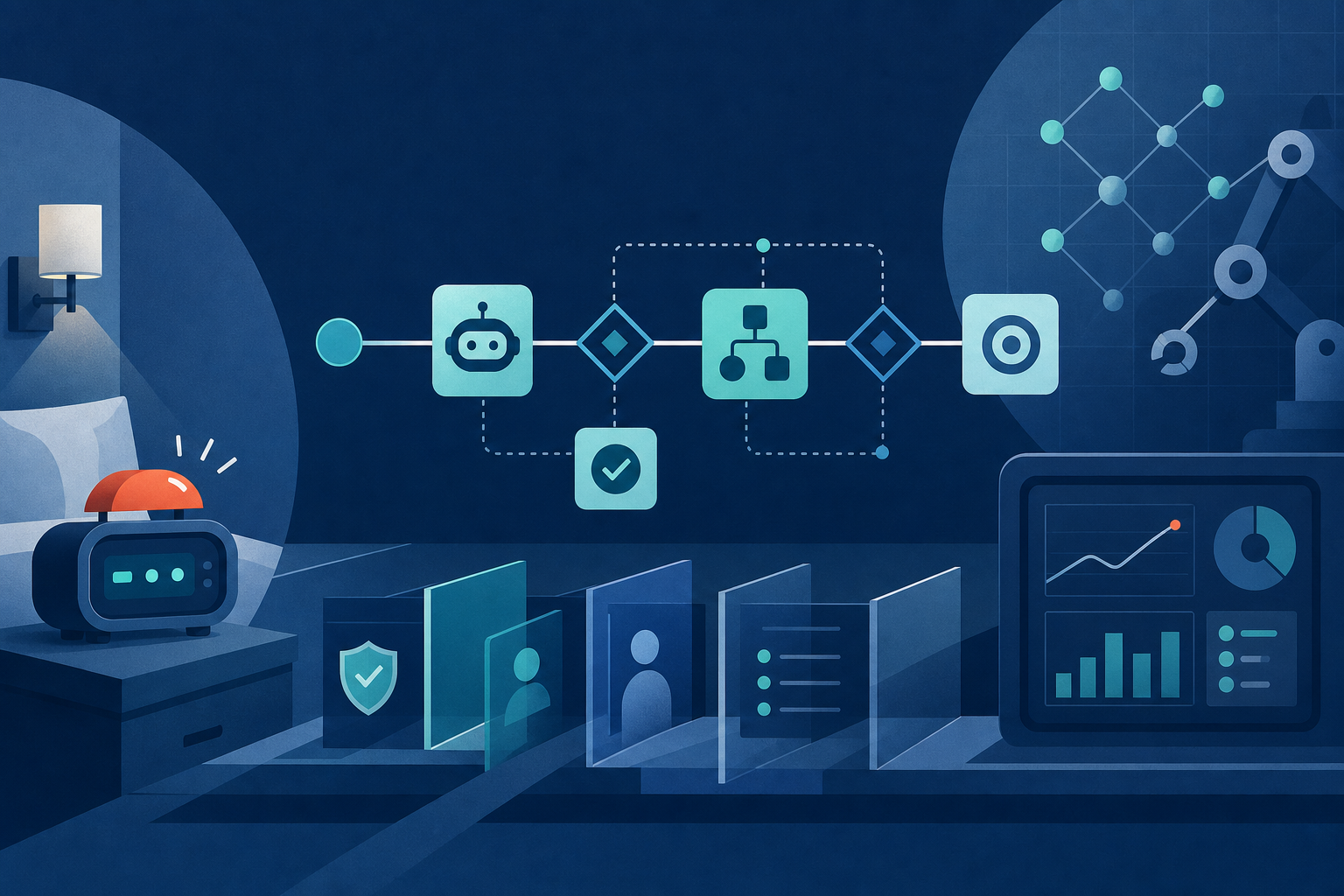
Swap the PBX for a scheduled agent and the pattern barely changes. A job runs on a schedule or a trigger, checks a condition against a live data source, and takes an action, usually an API call, a notification, or in more advanced cases, an outbound call or message. The LLM layer isn't doing anything mystical here. It's parsing unstructured input into a clean decision, formatting an output, or handling the handful of edge cases that would otherwise need a human on call.
Think renewal reminders that check policy status before texting a customer. Inventory thresholds that trigger a supplier order instead of an email nobody reads. Compliance deadlines that ping the right Slack channel with the actual document attached, not just "reminder: something is due." Same shape as the wake-up call. Higher stakes than a hotel guest missing a flight, usually, which is exactly why it deserves the same operational rigor, not less.
This is precisely the scope we target in a Pilot-to-Production Build: 6 to 10 weeks, milestone-based, moving a validated use case from prototype to a shipped, monitored workflow. Not a slide deck of what agentic AI could theoretically do for you. A running system with a defined trigger, a defined action, and a defined way to know if it worked.
If you're earlier than that, still figuring out which workflow deserves the build, that's what the AI Opportunity & Readiness Sprint is for: two weeks, fixed fee, one executable plan pointed at your highest-leverage workflow instead of five vague ones.
The PolicyFlow Math: Small Team, Small Timeline, Real Outcome
Here's the number that matters for a budget conversation: PolicyFlow, an AI-powered insurance data intake workflow, shipped in 3 months with one senior engineer plus an AI co-pilot. The traditional path for that same scope was a 4-person team over 12 months.
That's not a productivity anecdote, it's a staffing decision. If you're building next year's AI roadmap case right now, that comparison, one engineer and three months versus four people and a year, is the kind of hard number that survives a finance review. It's also the case for scoping small on purpose. PolicyFlow didn't succeed because the team was heroic. It succeeded because the workflow was scoped tight enough that a lean team with the right AI tooling could own it end to end.
SoloStream tells the same story from the cost side: one engineer, an AI co-pilot, about 3 months, roughly 80% lower cost than a traditional ~$500k build. Different domain, same lesson. Small, well-bounded, trigger-based workflows are where AI-accelerated teams outrun bigger, slower ones, not because AI is magic, but because the scope was honest.
If you're trying to figure out why your team shipped one workflow fine and is now stuck, that's a pattern worth reading about directly: why some teams ship their third AI workflow while others are still stuck on their first covers what changes (and what doesn't) once you're past workflow one.
Why the Boring Workflow Needs Eval Gates Too
A missed wake-up call ends a business relationship with a hotel. A missed renewal reminder, a malformed API call to a claims system, or a notification that fires with the wrong data attached does the same thing to an AI vendor relationship, just with worse legal exposure.
This is exactly where evaluation harnesses and quality gates matter, and it's non-negotiable for CTOs and CISOs signing off on production AI: time-sensitive, trigger-based workflows fail loudly and publicly when they fail. There's no ambiguity to hide behind. The call either went out or it didn't. The API call either matched the schema or it corrupted a record.
That means before a workflow like this ships, you want: a test suite that simulates the full range of trigger conditions, including the malformed and late-arriving ones; monitoring that flags a missed or delayed action within minutes, not at the next weekly review; and a clear boundary on what data the agent can touch and what actions it can take without a human check, the excessive agency question that shows up in the OWASP LLM Top 10 for a reason. Get this right on a small workflow and you've built the governance muscle you'll need before your second and third workflows get harder, which is the whole premise behind why your second AI workflow needs governance the first one never had.
The Toolkit Behind the Wake-Up Call
None of this requires building an agent framework from scratch. The specific agent and automation capabilities that make trigger-check-notify workflows reliable, scheduling, API orchestration, structured output validation, are documented on /skills, the toolkit we build these workflows with rather than a hypothetical one.
If you want to see this pattern applied outside of insurance intake, our shipped work shows the range: cross-industry builds, lean teams, and the same discipline about scope that made PolicyFlow and SoloStream work.
Ship the Boring One First
A production wake-up call doesn't need to impress anyone. It needs to ring on time, every time, and it needs a paper trail when it doesn't. That's the standard to hold your first AI workflow to, not "transformative," just reliable enough that nobody has to think about it again.
If you're heading into next year's planning cycle and need a hard-numbers example to point to, request the Pilot-to-Production case study breakdown starting with PolicyFlow: the timeline, the team size, and the milestones, laid out the way you'd present it to a budget committee. Then book an AI Opportunity & Readiness Sprint to find the equivalent workflow sitting in your own business.
Frequently asked
How long does it take to build an AI agent workflow?
It depends on scope, but a well-defined, single-purpose workflow (check a condition, call an API, send a notification) can go from validated prototype to shipped production system in 6 to 10 weeks with a milestone-based build. PolicyFlow, a more complex insurance intake workflow, shipped in about 3 months with a single senior engineer and an AI co-pilot.
What makes a good first production AI workflow?
The best first workflow is narrow, time-triggered, and has a clear pass/fail outcome: did the check happen, did the notification go out, was the API call valid. Avoid open-ended judgment calls for workflow one. Save ambiguity for later, once you've built the eval habits and monitoring to catch failures before they reach a customer.
How much does a production AI workflow cost compared to a traditional build?
Costs vary by scope, but the lean-team pattern holds: SoloStream was built by one engineer with an AI co-pilot in about 3 months, at roughly 80% lower cost than a traditional build estimated near $500k. PolicyFlow's 3-month, one-engineer build replaced what would have taken a 4-person team a full year.
Building AI into real operations is what we do.
Start a conversation