Why Your AI Pilot Breaks on Data That 'Looked Fine' When a Human Did It
AI pilots often fail not because the model is wrong, but because the manual process it replaced was quietly held together by a human's undocumented judgment calls. This post breaks down how to find that hidden work before automating it, and how evaluation harnesses catch it once you have.
The moment it always happens
It's usually week four or five. The pilot has been running clean for a couple of weeks, the demo looked great, and then someone on the team pulls up an output next to what a human would have produced and says some version of: "that's not how Denise does it."
The AI didn't hallucinate. It didn't crash. It processed the record exactly as specified. The problem is that the spec was wrong, because nobody ever wrote down what Denise actually does. She's been quietly fixing a mismatched customer ID, correcting a typo in a state abbreviation, and making a judgment call about which of two conflicting dates to trust, every single time, for two years. Nobody documented it because nobody thought of it as work. It was just her doing her job well.
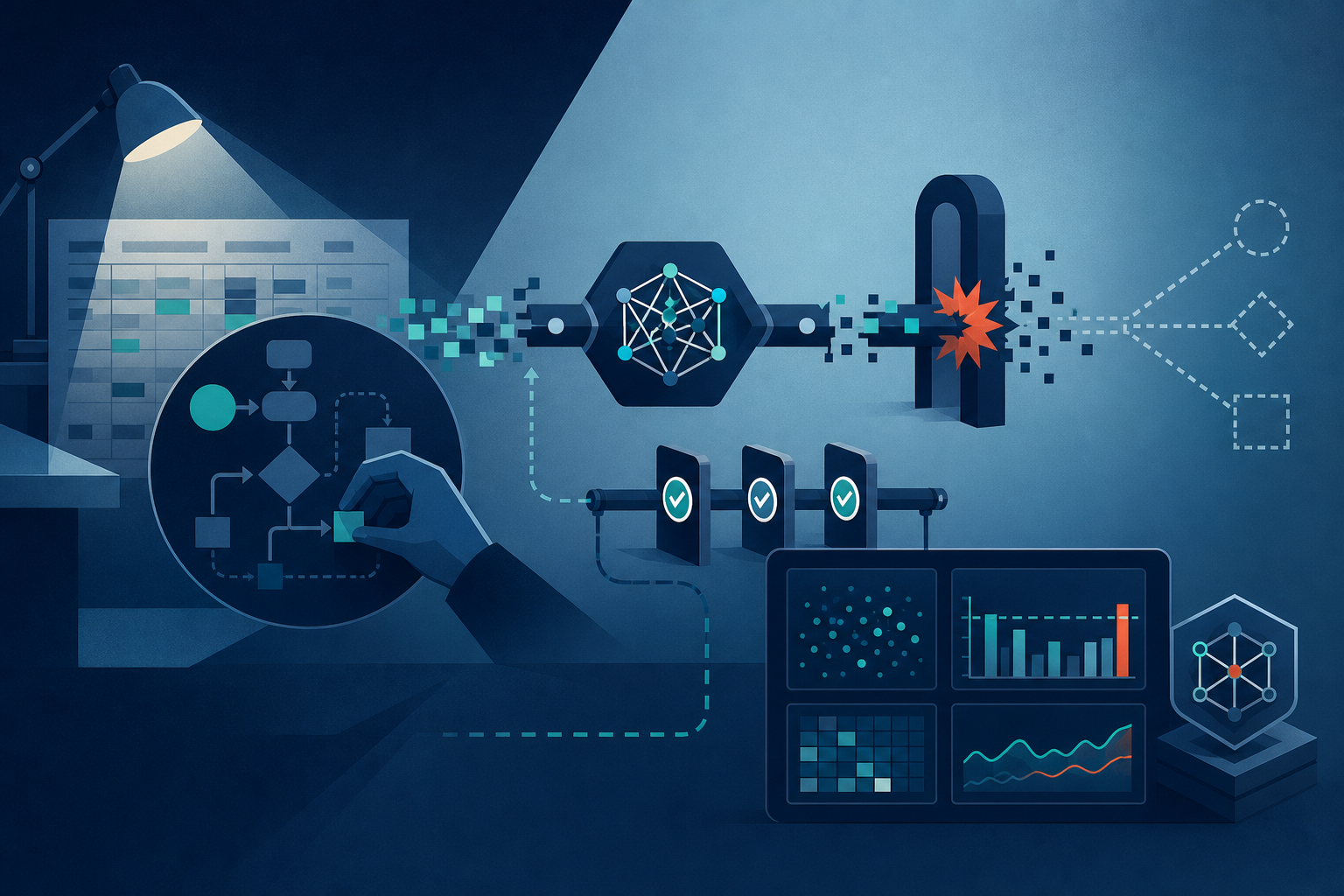
That silent cleanup is the actual workflow. The process map you built the pilot against was a map of the parts everyone could see.
Why the manual process looked simple in the first place
Human judgment is invisible by default. When a person handles an exception, they don't file a ticket saying "handled exception." They just handle it and move to the next thing in the queue. Over months or years, that accumulated judgment becomes the process, even though the org chart, the SOP doc, and the training materials still describe the clean, exception-free version.
This is why a readiness conversation that only asks "can you walk me through the process" almost always produces an incomplete answer. The person answering isn't hiding anything. They genuinely don't remember that reconciling the vendor name against three possible spellings is a decision they make, because they've made it four thousand times and it feels like breathing.
So when you scope an AI workflow off that description, and the outputs come back technically correct against the documented rules, you've built something that's accurate to a spec that was never complete. It looks like an AI quality problem. It's actually a discovery problem that happened too late.
What proving the manual process is clean actually looks like
This is readiness work, not red tape, and it's cheaper to do before you build than to find out mid-pilot. Three things matter here:
Pull 4 to 6 weeks of real inputs and outputs. Not a sample someone picked because it looked representative. Actual production data, actual edge cases, actual weird Tuesday where the vendor sent the file in a different format. You're looking for the gap between what came in and what went out, and that gap is where the judgment lives.
Trace every exception path, not just the happy one. Every process has a documented main path and an undocumented set of "well, except when..." branches. Those branches are usually where the real risk sits, and they're exactly what a first pass at process mapping misses.
Ask the person doing the job to narrate their edge cases out loud, in real time, on real records. Not from memory, not in a retrospective interview. Watch them work and ask "wait, why did you change that field" the moment it happens. That's the only reliable way to surface work the person doesn't know they're doing.
This is precisely the work we run inside an AI Opportunity & Readiness Sprint: two weeks to find out whether the workflow you want to automate is the workflow that's actually happening, before you spend six to ten weeks building against the wrong one.
The fix isn't just finding it once. It's catching it forever.
Here's the part teams get wrong even after they've had the uncomfortable mid-pilot conversation: they fix the specific case Denise flagged, ship the patch, and move on. That treats the discovery as a one-time bug instead of a signal that the workflow needs an ongoing way to catch what a human used to catch.
That's what an evaluation harness and quality gate are for. Not a demo-time sanity check, but a standing mechanism that scores real outputs against real judgment calls on an ongoing basis, so the next silent-cleanup case gets caught before it reaches a customer, a claims file, or a regulator, instead of after. We've written about why "seems fine" isn't a metric and what the quality gate before your next AI workflow actually needs to check; this is the same discipline, applied to the workflow you already shipped.
On PolicyFlow, the insurance intake workflow we built with one senior engineer and an AI co-pilot in three months, this kind of exception tracing wasn't a nice-to-have step. It was the difference between a workflow that handled messy real-world submissions and one that only worked on the clean sample data from the sales deck.
What this actually costs each type of team
For an SMB or mid-market team shipping a first production AI win, this is the difference between that win and a quiet failure that erodes trust in AI projects for the next two years. You don't get many shots at a first win. Spend the time proving the manual process is clean before you spend the build budget.
For enterprise teams, this is a governance issue whether or not anyone's called it that yet. Undocumented human judgment is an undocumented control, and if you're mapping to NIST AI RMF or ISO 42001, an auditor is eventually going to ask how you know the automated process makes the same decisions the manual one did. "We didn't know Denise was doing that either" is not an answer you want to give in that meeting. If your agent has any write access at all during this process, it's worth reading how excessive agency turns an undocumented judgment call into an undocumented permission.
For startups scaling past their first workflow, this is a founder-mode trap: the process that got you to Series A ran on three people's tribal knowledge, and it will not survive being handed to an agent that only knows what's written down. Founders assume that because a process runs today, it's been specified. It hasn't. It's been performed, by someone who's good at their job.
Before you build the next one
The pattern repeats every time a team automates a new workflow, because every workflow has its own Denise, its own set of quiet fixes nobody wrote down. The teams who catch it early treat readiness as the actual first phase of the build, not a formality before the real work starts.
If you want a straight answer on whether the workflow you're eyeing next is actually ready, or whether it's still running on undocumented judgment calls, download the AI readiness framework we use to trace manual-process cleanup work before it becomes a production incident.
Frequently asked
Why do AI pilots fail on data that seemed fine during testing?
AI pilots fail because the manual process they replaced relies on undocumented human judgment calls. The person performing the work—like Denise fixing mismatched IDs or correcting typos—doesn't see this as separate tasks. These silent cleanups become the actual workflow, but the process map built for the pilot only describes the visible parts.
How can you discover the hidden work in a manual process before automating it?
Asking people to walk through their process produces incomplete answers because they don't consciously register routine judgment calls they've made thousands of times. You need to look beyond documentation and SOPs to find the exceptions and reconciliations that have become invisible, automatic parts of the job.
What role do evaluation harnesses play in catching misaligned AI outputs?
Evaluation harnesses catch the gap between what the AI spec says and what humans actually do. They help surface discrepancies between AI outputs and human-produced work, revealing where the AI was built against an incomplete process map that missed the undocumented judgment calls.
Building AI into real operations is what we do.
Start a conversation