Why Your Second AI Product Can't Reuse Your First One's Architecture
Founders assume their second AI product will be as fast as the first, but speed only compounds if tooling (prompts, scripts) was separated from architecture (eval gates, data boundaries, governance hooks) from day one. This post names the trap, prices out what rebuilding from scratch actually costs in engineering weeks, and gives a concrete checklist for keeping product two an iteration instead of a rebuild.
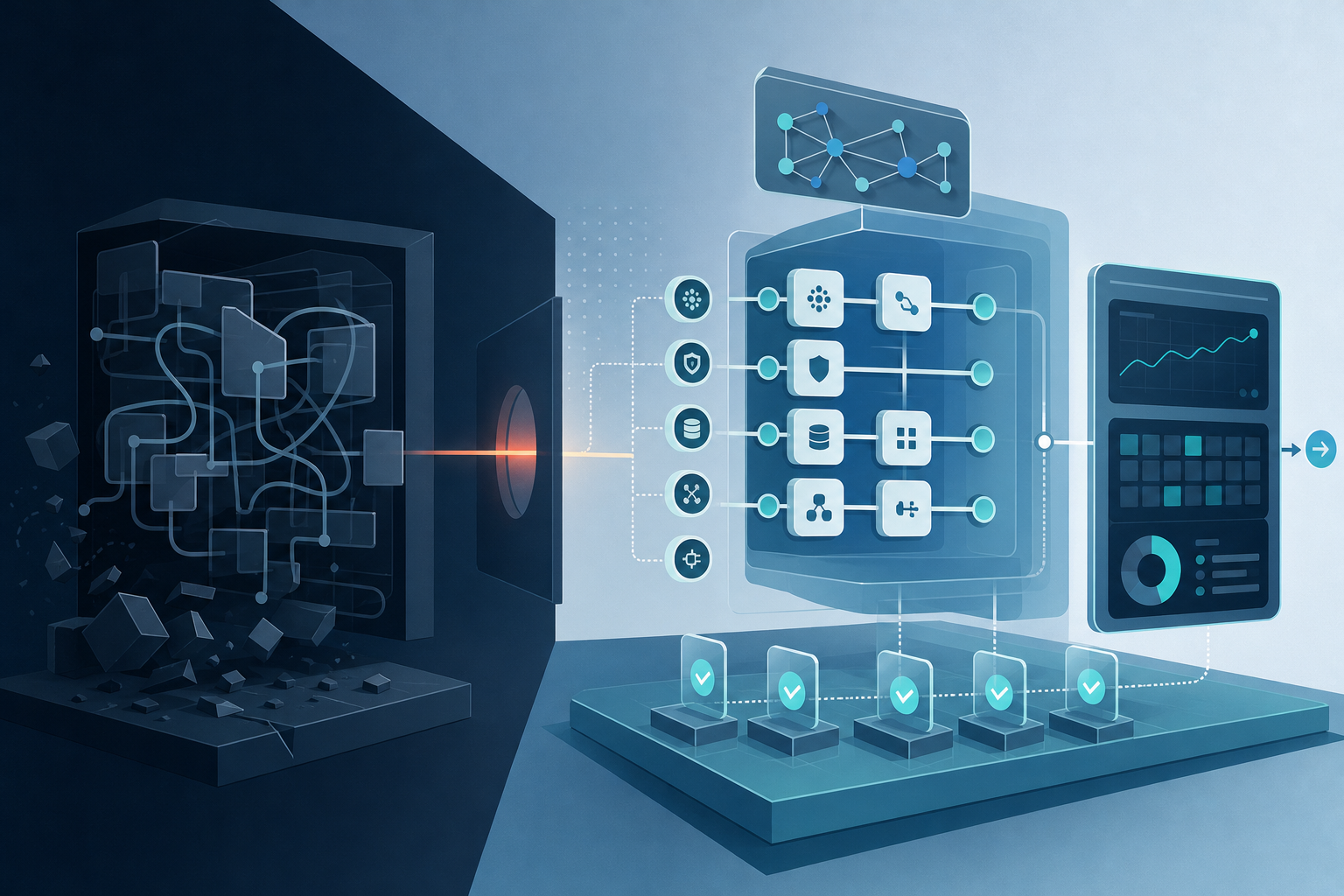
Why can't I reuse my first AI product's architecture for my second one?
Because it was never architecture. It was a prototype that happened to work, with the prompts, the eval script, the data pipeline, and the actual system design all fused into one undifferentiated pile of decisions made under deadline pressure. Product one shipped because the problem was bounded and the data was clean enough to paper over the mess. Product two doesn't get that luxury, and that's the exact moment founders discover they built a one-off instead of a system.
This is the conversation happening in planning docs right now, as teams scope next year's AI roadmap and assume build two will be faster because build one was fast. It won't be, unless you did something on build one that almost nobody does on their first try: separate the tooling from the architecture.
What "rebuilding from scratch" actually costs
Here's what it looks like when teams find out the hard way. The eval harness from product one was three Jupyter cells and a spreadsheet of expected outputs, hardcoded to that product's schema. Product two needs its own, from zero, because nothing about the first one generalizes. That's one to two weeks gone before a single feature ships.
The data boundaries were implicit: whoever wrote the prompts knew which fields were safe to pass to the model and which weren't, because they'd built the whole thing and held it in their head. Product two has a different team, or the same team six months later with half of it forgotten, and now someone has to re-derive which data the agent can touch, re-litigate the governance question with security, and document it this time because governance that breaks on workflow two is now a familiar, expensive pattern. Add another week or two, more if the data touches anything regulated.
The integrations were wired directly into the first product's business logic instead of sitting behind a clean interface. So instead of pointing product two at an existing MCP or RAG layer, someone is re-architecting the connection from scratch, re-solving a problem that was already solved once and just never got extracted into something reusable.
Add it up and you're looking at four to six weeks of pure re-derivation before product two's actual new logic gets touched. None of that time produces anything a user sees. It's the tax on not separating tooling from architecture the first time.
Why speed on your first build doesn't guarantee speed on your second
PolicyFlow shipped in about three months: one senior engineer plus an AI co-pilot doing what would've taken a four-person team a year. SoloStream did it too, at roughly 80% lower cost than a traditional build. Those numbers are real, and they're also conditional. They compound into similarly fast second builds only if the eval gates, data boundaries, and integration points were built as separable components from day one. If they weren't, the three-month number doesn't carry forward. It resets, because the team is re-earning the same ground.
Speed on build one proves the team can move fast under pressure. It doesn't prove the system was built to be extended. Those are different claims, and conflating them is exactly how a team ends up surprised that workflow two is harder than workflow one when nothing about the business problem got harder.
The separation checklist: what's disposable versus what's durable
Before you scope product two, sort what you built into two buckets.
Disposable tooling (expect to throw this away and that's fine):
- Prompt iterations and few-shot examples tuned to product one's specific phrasing
- One-off scripts that glued the pipeline together for a demo or launch
- Manual QA spreadsheets used to eyeball outputs before a real eval existed
Durable architecture (this should survive into product two unchanged or lightly extended):
- Evaluation harnesses with defined pass/fail thresholds, not vibes-based review (see why "seems fine" isn't a metric)
- Data access boundaries: documented, not just understood by whoever wrote the code
- Governance hooks mapped to actual agent decisions, ready for NIST AI RMF or ISO 42001 scrutiny
- The MCP/RAG retrieval layer that connects the system to your proprietary data
If your first build mixed these two buckets into one undifferentiated thing, that's normal. Almost everyone's first AI product looks like this, because you're solving the business problem and the system design problem at the same time, and the business problem wins every tradeoff. The mistake isn't building it that way once. It's scoping product two without going back and pulling the two apart first.
Separate it before you scope product two, not during
This is what our AI Opportunity & Readiness Sprint is actually for: a two-week engagement that forces the tooling-versus-architecture split into the open before a second build starts, so the plan for product two is explicit about what's being reused and what's being rebuilt. For teams running multiple AI products across multiple teams, the AI Enablement Retainer keeps that separation intact as the footprint grows, so eval gates and data boundaries don't quietly re-fuse with tooling every time someone's in a hurry.
If you're staring at a budget doc right now trying to figure out whether product two is a six-week iteration or a twelve-week rebuild, that answer is sitting in how separated your first build actually was. Most founders don't know, because nobody audited it. Read how we structure that separation in a Pilot-to-Production Build, then book an AI Opportunity & Readiness Sprint at https://horizontwolabs.com before product two gets locked into next year's plan.
Frequently asked
What should be reusable in an AI system architecture?
Evaluation gates, data boundaries and access rules, governance hooks, and your MCP/RAG retrieval layer should all be reusable. These are structural: they define how the system checks quality, who can touch what data, and how it connects to your proprietary knowledge. Prompts and one-off scripts are not structural. They're disposable by design, which is fine as long as you never confuse them with the parts that should last.
How do you separate AI tooling from architecture?
Draw the line at what changes weekly versus what should survive a model swap. Prompt text, few-shot examples, and quick test scripts are tooling: expect to throw them away. Eval harnesses, data boundary definitions, and governance hooks are architecture: build them once, version them, and make product two call into them instead of rebuilding them.
How should I plan next year's AI roadmap if I've only shipped one AI product?
Before you scope product two in planning docs, audit what from product one is genuinely reusable versus what just happened to work once. If your eval harness, data boundaries, and governance hooks aren't documented and separated from your prompts, budget time to extract them now, not mid-build when the second product is already behind schedule.
Building AI into real operations is what we do.
Start a conversation