Your AI Workflow Works. Is It Actually Cheaper Than What It Replaced?
Most evaluation harnesses measure whether an AI workflow works, but not whether it's cheaper per transaction than the manual process it replaced; this piece walks through how to build a cost-aware eval gate before scaling one workflow into many.
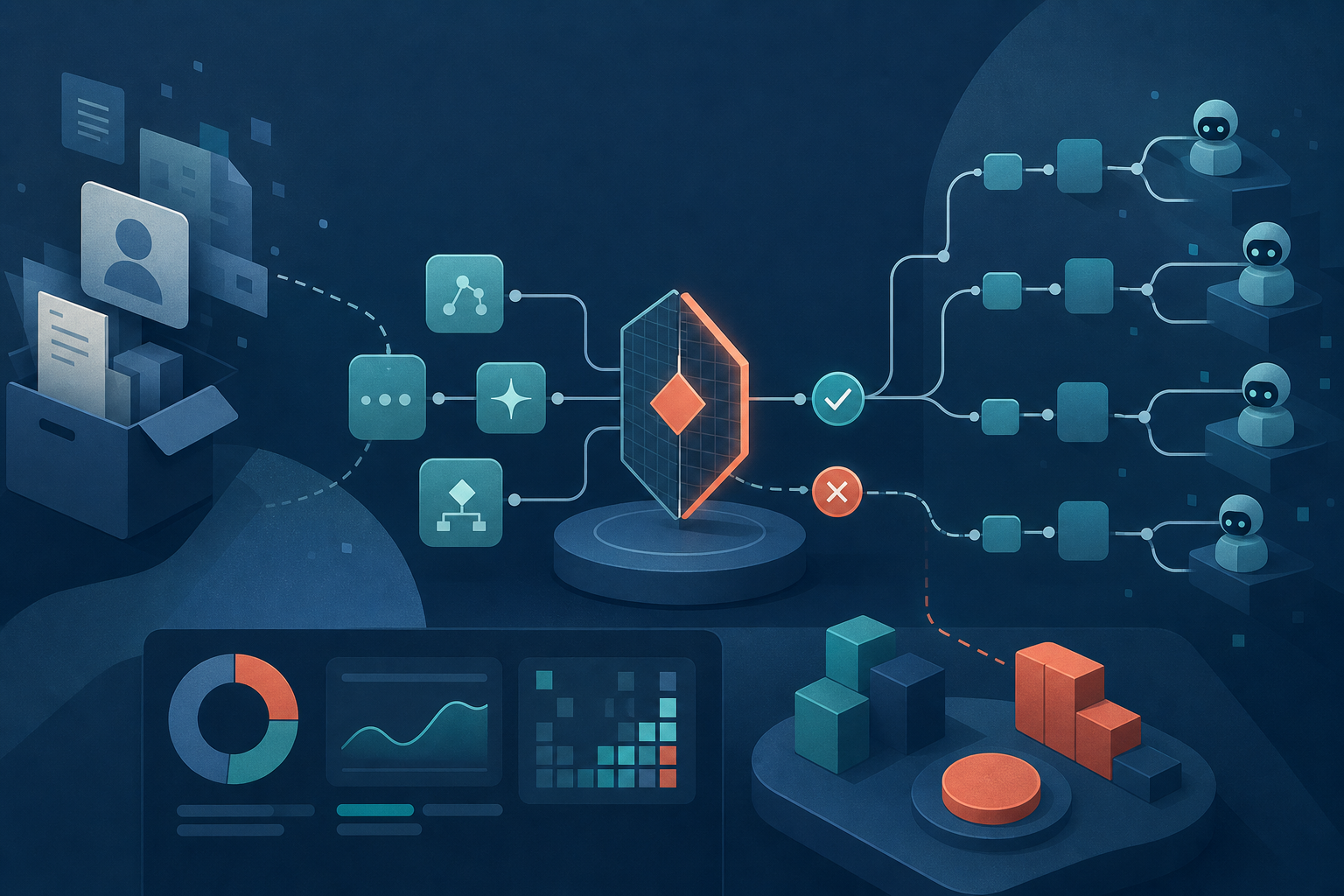
The Question Your Eval Harness Never Asks
Your eval harness probably tracks accuracy, hallucination rate, and task completion. Good. Those numbers tell you the workflow works. They tell you nothing about whether it's cheaper than the analyst, the intake team, or the spreadsheet process it replaced.
That's a different question, and it needs different metrics. "Does this work?" is a quality question. "Does this work for less than what we're replacing?" is a cost question, and it's the one most teams skip because it's less fun to build and easier to assume.
Six-plus months into the year, that gap matters more than it did in January. Plenty of teams are past the first pilot and deciding what to scale from one workflow to five. If nobody's checked the per-transaction math on workflow one, you're about to multiply an unverified cost structure across a lot more volume. That's not scaling a win. That's scaling a guess.
Why a 95% Success Rate Can Still Be a Losing Trade
Here's the trap in plain terms: a workflow that completes the task correctly 95% of the time and costs more per unit than the human process it replaced isn't a win. It's a more expensive mistake with better PR.
Quality metrics measure whether the model got the right answer. They don't touch:
- Token and API cost per transaction, especially when a workflow chains multiple calls or falls back to a bigger model on ambiguous inputs
- Retry cost, when the first pass fails validation and the system tries again (each retry is a second bill, not a rounding error)
- Human-in-the-loop review time, when someone still has to check the output before it ships, which is real labor cost that doesn't disappear just because AI touched the file first
- Infrastructure and orchestration overhead, the vector database, the queueing, the monitoring, all the plumbing that keeps the workflow running
Add those up per transaction and compare that number to what the manual process actually cost per transaction; not what you assumed it cost, what it actually cost. If you skipped that baseline, you're not running an evaluation. You're running a vibe check with a dashboard attached. We've written before about why "seems fine" isn't a metric, and the same logic applies here: a quality gate that never checks cost is only half a gate.
What a Cost-Aware Eval Harness Actually Measures
A harness built to answer the cost question looks different from one built to answer the accuracy question. It's tracking a per-unit number, not just a pass/fail score.
Concretely, that means instrumenting for:
Cost per transaction, broken down by stage
How much does one completed transaction cost, all-in? Tokens in, tokens out, any tool calls, any retries, any human review minutes converted to a loaded hourly rate. One number, fully loaded, comparable to the manual baseline.
Retry and failure cost, not just failure rate
A 5% failure rate sounds fine until you realize each failure triggers a retry that costs as much as the original attempt, plus a human escalation. Failure rate times retry cost is the number that actually matters.
Human-in-the-loop time, tracked like a line item
If a person still reviews every output, that's not a footnote, that's a cost center. Track minutes per review and multiply by loaded cost. If review time doesn't shrink as the model improves, the workflow isn't actually automating anything, it's adding a step.
This is the exact comparison PolicyFlow ran, whether the team called it that or not: one senior engineer plus an AI co-pilot shipped in three months what would've taken a four-person team twelve months. That's a build-cost comparison and a structural one, headcount and timeline, measured against the alternative. Every workflow you're deciding whether to scale deserves the same treatment: what did the old way cost per unit, what does the new way cost per unit, and is the gap big enough to be worth the engineering risk.
Why Mid-Year Is Exactly When This Bites
This is the point in the year when teams look at six-plus months of production data and decide what graduates from pilot to portfolio. That's the right instinct. It's also the moment unchecked cost creep goes from annoying to expensive, because you're not running the workflow at the same volume anymore, you're about to run it at 3x or 10x.
A workflow that quietly costs 20% more per transaction than the manual process it replaced is a rounding error at low volume. At scale, across every workflow you're rolling out next, it's a real number on a real budget, and it compounds with every additional workflow you stack on top of it. This is part of why your second AI workflow is often riskier than your first: the assumptions from workflow one get inherited by workflow two without anyone re-checking them.
If you're an engineering or security leader weighing what to scale, this is also the moment to pair cost review with governance review, not after. Cost creep and permission creep tend to show up together.
Building the Kill/Scale Gate Before You Scale, Not After
A real cost-aware evaluation gate has three parts, and they happen in this order:
- Baseline the manual process cost first. Before you write a line of eval code, get an honest number for what the current process costs per transaction: labor, error correction, time. If you don't have this, you have nothing to compare against.
- Instrument the AI workflow for cost-per-unit from day one. Not after it's in production, from the first pilot run. Token spend, retry rate, human review minutes, all rolled into one per-transaction figure.
- Set the kill/scale threshold before you scale, not after. Decide, in advance, what cost delta justifies scaling this workflow to more volume or more use cases. Doing this after you've already committed budget and headcount to scaling means you're rationalizing a decision you've already made, not evaluating one.
That order matters. Baseline, then instrument, then threshold. Skip step one and you're comparing your AI workflow to nothing. Skip step three and you'll scale first and ask questions later, which is how teams end up running an expensive mistake at 5x volume instead of a cheap win.
Check the Math Before You Multiply It
If you're not sure your production workflows are actually cheaper than what they replaced, that's worth finding out before your next scaling decision, not after. The AI Enablement Retainer exists for exactly this: ongoing evaluation and governance across your growing AI footprint, so the workflows you scale are the ones that earned it. Start at horizontwolabs.com.
Frequently asked
What's the difference between quality metrics and cost metrics for AI workflows?
Quality metrics measure whether the model got the right answer—accuracy, hallucination rate, task completion. Cost metrics measure whether the workflow is cheaper per transaction than the manual process it replaced, accounting for token costs, retries, and human review time.
Why can a 95% accurate workflow still be unprofitable?
A high success rate doesn't guarantee cost-effectiveness. If per-unit costs exceed the manual process it replaces, accounting for tokens, API calls, retries, and human review labor, the workflow is a more expensive mistake despite good quality metrics.
Why should teams verify workflow economics before scaling?
Scaling an unverified cost structure multiplies financial risk across many workflows. Before expanding from one pilot to five, teams must validate that per-transaction math proves cheaper than what it replaced, or risk scaling a losing trade.
Building AI into real operations is what we do.
Start a conversation