Your AI Readiness Assessment Is Testing the Wrong Thing
Most AI readiness checklists measure ML literacy when they should measure process consistency. This post breaks down the actual audit (using PolicyFlow as proof) that predicts whether a workflow is ready to automate, and why it's the artifact to bring into next year's budget conversation.
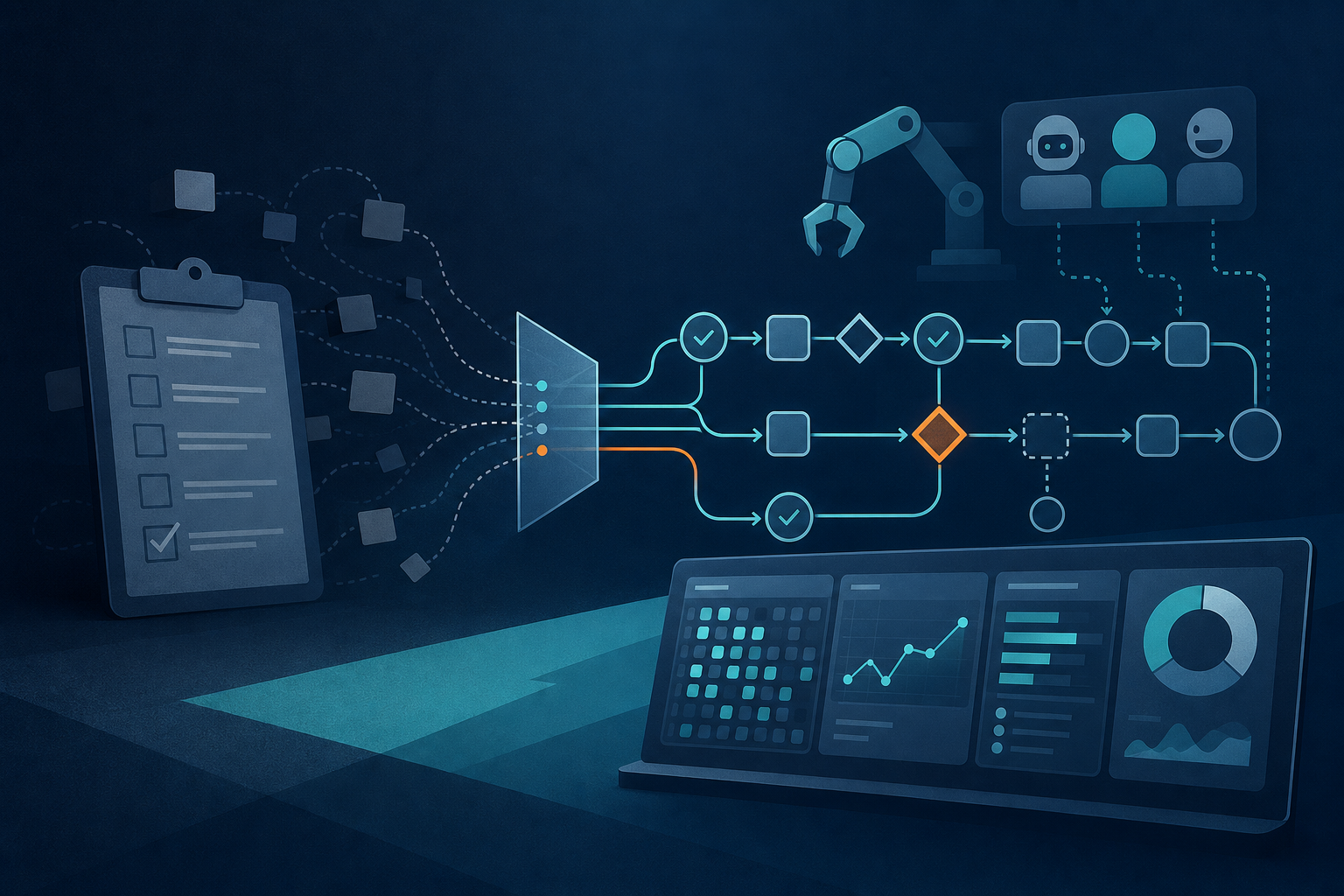
The Readiness Quiz Is Measuring the Wrong Thing
Most AI readiness checklists ask whether your team can define a transformer model. Whether someone's read a whitepaper on RAG. Whether your VP of Engineering can explain the difference between fine-tuning and prompt engineering at a dinner party. None of that predicts whether a pilot survives contact with production.
Here's the test that actually matters: is your manual process consistent enough to automate? Not sophisticated. Not documented in a beautiful Notion doc. Consistent. Do the five people who run this workflow today make the same decisions in the same order, or does each one quietly run their own version of the job?
That's the failure mode nobody names directly, so we will: teams keep scoring their ML literacy when they should be scoring their process variance. It's the wrong test, and it's a big reason pilots stall in the demo stage and never ship.
Why Process Inconsistency Kills Automation Before the Model Gets a Turn
An AI model, agentic workflow, or RAG pipeline needs something to be evaluated against. Call it ground truth: a defined "correct" output for a given input, so you can build an evaluation harness and know when the system is right, wrong, or drifting.
If five people handle the same intake form five different ways, there is no ground truth. There are five ground truths, and they disagree with each other. You can't write an eval for "sometimes we escalate, sometimes we don't, depending on who's on shift and how they're feeling about it." That's not a workflow, it's five workflows sharing a job title.
This is also why so many AI wins don't replicate. A team ships one workflow successfully, tries to repeat the trick on workflow two, and gets stuck, usually because the decision logic in the second workflow was never actually documented, just carried around in someone's head. We wrote about exactly this pattern in why workflow two gets stuck when the decision logic was never written down, and it's the same root cause every time: undocumented human judgment masquerading as a process.
The uncomfortable part: a lot of "judgment calls" your team makes aren't judgment at all. They're undocumented rules. Someone learned them on the job, never wrote them down, and now calls the resulting behavior "experience." An audit's job is to tell the difference between real judgment (genuinely ambiguous, case-by-case) and unrecorded rules (consistent, just never written anywhere).
What the 2-Week Readiness Sprint Actually Checks
Our AI Opportunity & Readiness Sprint doesn't open with a model discussion. It opens with a process audit, because that's the actual bottleneck. Here's the sequence:
Map the current-state workflow, step by step
Not the org chart version. The real one: who touches the work, in what order, with what inputs, and what they hand off. This alone surfaces gaps most teams didn't know existed, because the documented process and the lived process are rarely the same thing.
Check for decision-point variance
At every branch point, we ask: does this decision get made the same way regardless of who's making it? If three underwriters flag the same claim for review, that's consistent, and automatable. If two flag it and one doesn't, that's variance, and it needs to get resolved (via a written rule) before any model touches it.
Separate real judgment from undocumented rules
This is the step most readiness checklists skip entirely. A lot of "it takes a human's intuition" turns out to be five if-then rules nobody wrote down. Once they're written down, they're automatable. Once they're genuinely case-by-case and context-dependent, that's where a human stays in the loop, by design, not by default.
Only after that mapping is done do we talk about what kind of AI workflow fits: a straightforward automation, an agentic system, a RAG-based lookup. The model choice is downstream of the process audit, never upstream of it. If you want the fuller picture of how we scope and build once that audit's done, that's what the Services page walks through.
Proof: PolicyFlow Didn't Need ML Experts, It Needed a Clean Process
PolicyFlow, our insurance data intake build, is the clearest example we have. The client didn't have a team of ML PhDs. They had a well-defined process: clear intake steps, consistent decision points, documented exceptions. That consistency is what let one senior engineer plus an AI co-pilot ship in three months what would otherwise have taken a four-person team a year.
The ML literacy wasn't the unlock. The process clarity was. That's the entire argument, condensed into one build.
Compare that to a workflow where the "rules" live in five different people's heads, five different ways. No amount of team AI fluency fixes that gap. You'd be automating chaos faster, which is worse than not automating it at all.
Bring a Process Audit Into Next Year's Budget Conversation, Not a Quiz Score
Right now, leaders are building the case for next year's AI spend. The instinct is to walk into that budget conversation with a vendor comparison deck, or a readiness quiz score that says your team is
Frequently asked
How do I know if my process is consistent enough to automate?
Watch five people do the same task and count the differences. If they make the same decisions in the same order, with exceptions you can name, you have ground truth to build an evaluation harness against. If everyone improvises, you don't have a process, you have five processes wearing one job title, and no model fixes that.
Why do AI pilots fail before they reach production?
Most pilots die because the underlying workflow was never mapped and standardized before a model got involved. Without documented decision points, there's nothing to evaluate the AI's output against, so teams can't tell if it's working, and the pilot stalls in permanent demo mode instead of shipping.
What should I bring into next year's AI budget conversation?
Bring a process audit, not a vendor comparison. Show which workflows have low decision-point variance (automatable now), which have undocumented judgment calls (need documentation first), and which aren't worth touching yet. That artifact survives CFO scrutiny in a way a readiness quiz score never will.
Building AI into real operations is what we do.
Start a conversation